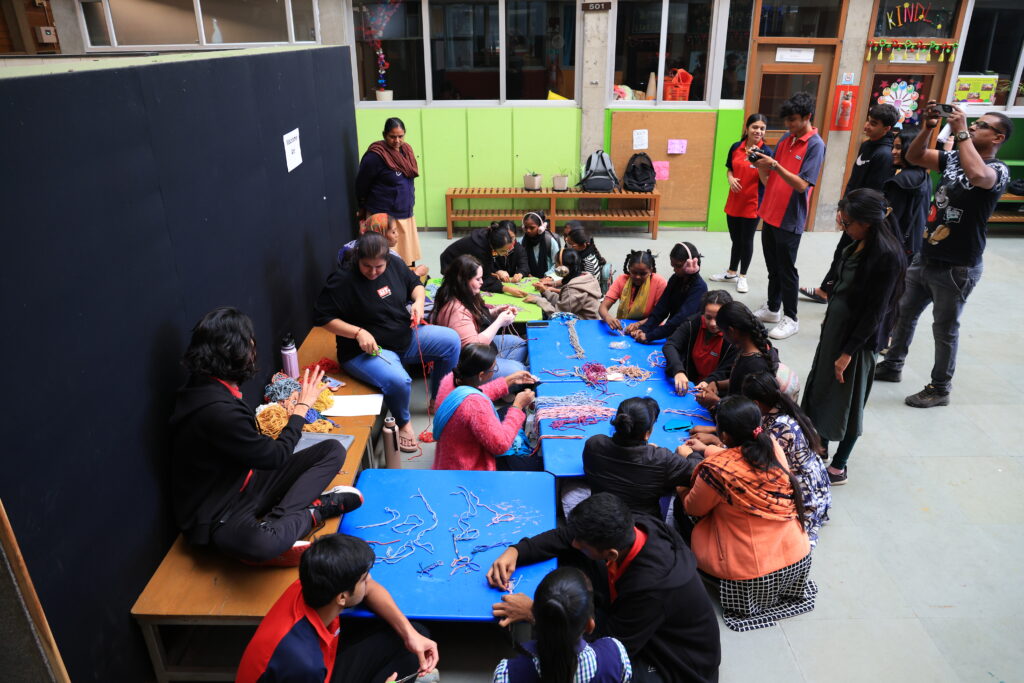
Bal Mela is an annual event hosted by our school, where our students engage with other students from impoverished schools by teaching them various creative arts and participating in physical activities such as sports. Bal mela was an engrossing event for me where I not only had the opportunity to teach Macrame to others, but I was also able to learn the skill myself.
LO2 – Demonstrate that challenges have been undertaken, developing new skills in the process.
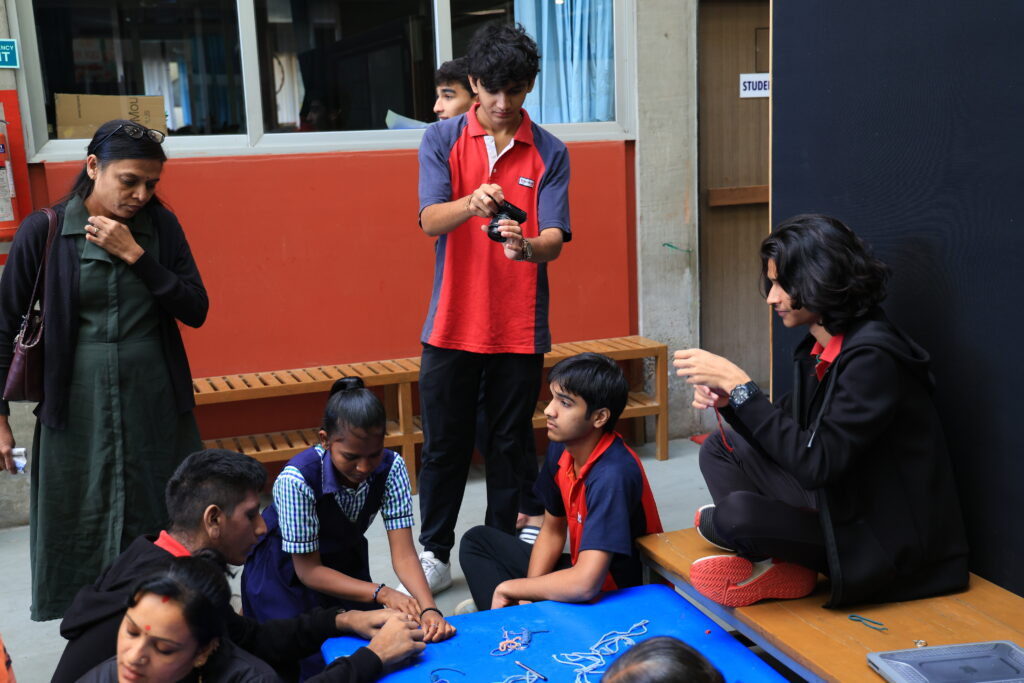
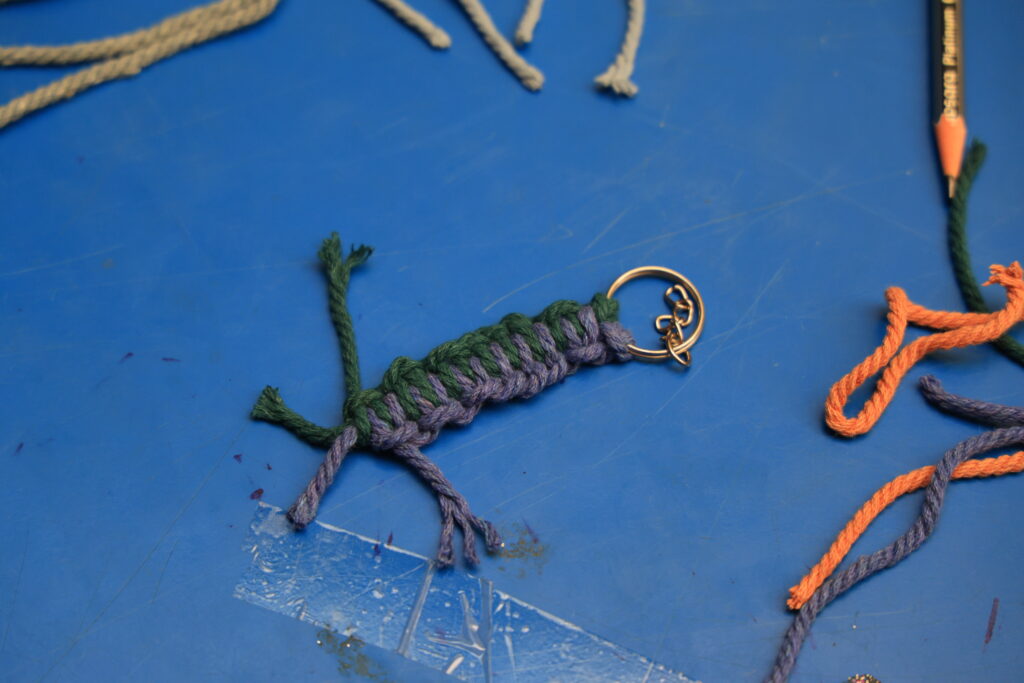
Initially, I was assigned to create newspaper hats and flowers, so I prepared to learn the art through YouTube tutorials a night ago. However, on arrival at the venue, we found out that the Macrame stall was understaffed, and we needed student volunteers to fill the vacancy. Despite having zero prior knowledge about Macrame, I decided to participate as I was curious about learning the new art form. Hence, I and my friends began by watching YouTube tutorials quickly before the students arrived and learned a basic technique called “the square knot” to teach to the students. We were doing Macrame on keyrings to potentially create keychains, which could be given away to the students participating in the activity. But after creating a couple of keychains, I was dissatisfied by just teaching them a square knot when there is so much more to Macrame. Hence, I borrowed my friend’s laptop and spent the next 30 minutes learning a new technique that required four threads instead of two which we were using earlier. This led to my friends reprimanding me because, well, my attention was shifted towards learning a new technique instead of teaching the existing technique to children spontaneously coming to our stall. But I couldn’t call it a fruitful day if I wasn’t able to learn something new myself. Therefore, after learning the four-thread technique, I began teaching them to the upcoming students in our stall.
LO4 – Show commitment to and perseverance in CAS experiences.
For Bal mela, I dedicated myself to teaching macrame, a craft I had only recently learned but was eager to share. Despite being new to it, I was curious about learning the art as it was rather Seeing their curiosity and excitement as they knotted the threads was incredibly rewarding, and I found myself deeply invested in making the experience enjoyable for them. I wanted them to leave not just with a handmade piece but with the joy of creating something with their own hands. It wasn’t just about teaching a skill—it was about sharing a sense of accomplishment and creativity, which made every moment of preparation worth it.
LO6 – Demonstrate engagement with issues of global significance.
This experience can be linked to the SDGs, quality education and reduced inequalities.
While teaching macrame, I sat with a boy, showing him how to do the 4-string technique I just learnt. He picked it up quickly, and his concentration was profound. “You’ve got the hang of it,” I said, and he looked up, seeming surprised. “We don’t really get to do this kind of stuff in school,” he admitted. He mentioned how his classes were packed, and there wasn’t much time for hands-on activities. I hadn’t thought much about it before, but hearing him say that made me appreciate how different our learning experiences were. Well, it wasn’t anything grand, but seeing how engaged he was made me feel like I was doing something worthwhile—helping him enjoy learning in a way he normally didn’t get to.
The contrast between a privileged student and an impoverished one is stark, not just in terms of resources but also in the opportunities available to them. While students in well-funded schools have access to extracurricular activities, advanced learning materials, and personalized support, many in underprivileged schools struggle with overcrowded classrooms and outdated resources. These differences extend beyond academics—confidence, exposure, and the ability to dream bigger are shaped by the environment one grows up in. It’s not about intelligence or potential; it’s about access. Events like Balmela highlight this divide, but they also serve as a reminder that even small efforts—whether it’s introducing a new skill or simply offering encouragement—can make a difference in closing the gap.
Conclusion
Consequently, the experience was interesting for me, as I got to learn a new skill that day. However, I regret not exploring other activities, such as dance or a sport, which I could have learned first and then taught to the children. Unfortunately, that wasn’t possible since Macrame was understaffed.
I’ll admit that while watching YouTube tutorials, I was so caught up in the process of learning that, for a brief moment, I forgot about the actual teaching. But once I started guiding the students, I realized that the real joy wasn’t just in learning but in passing that knowledge on. Seeing their excitement as they completed their designs made the effort worth it. By the end of the day, I had taught macrame to a lot of students, and while it wasn’t perfect, it felt fulfilling to teach an art that even I had just discovered.