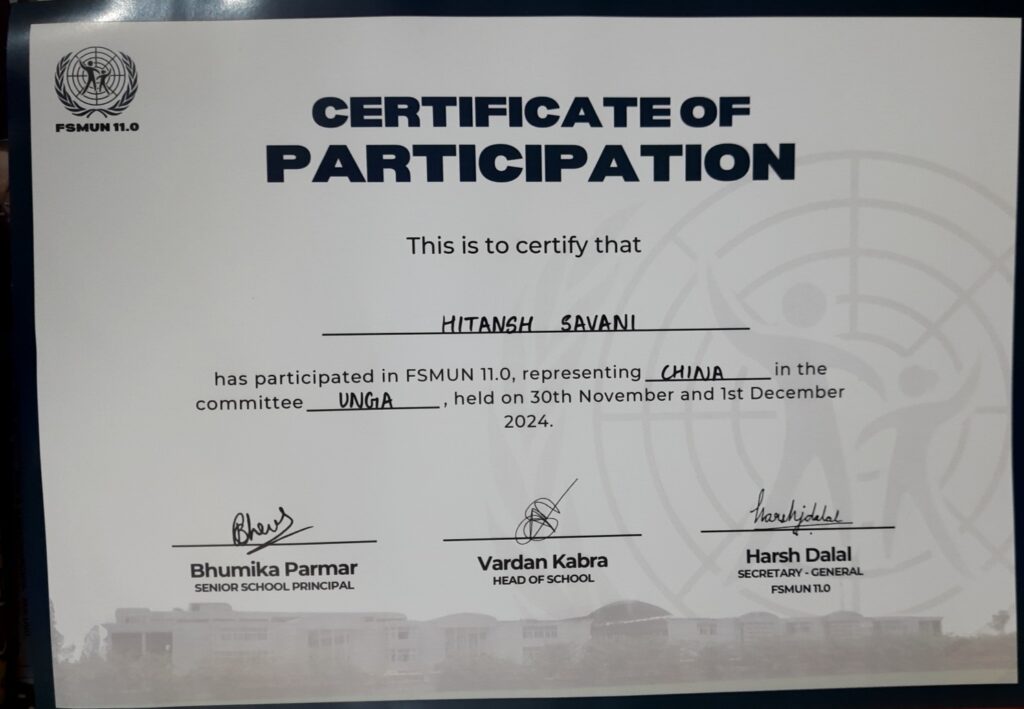
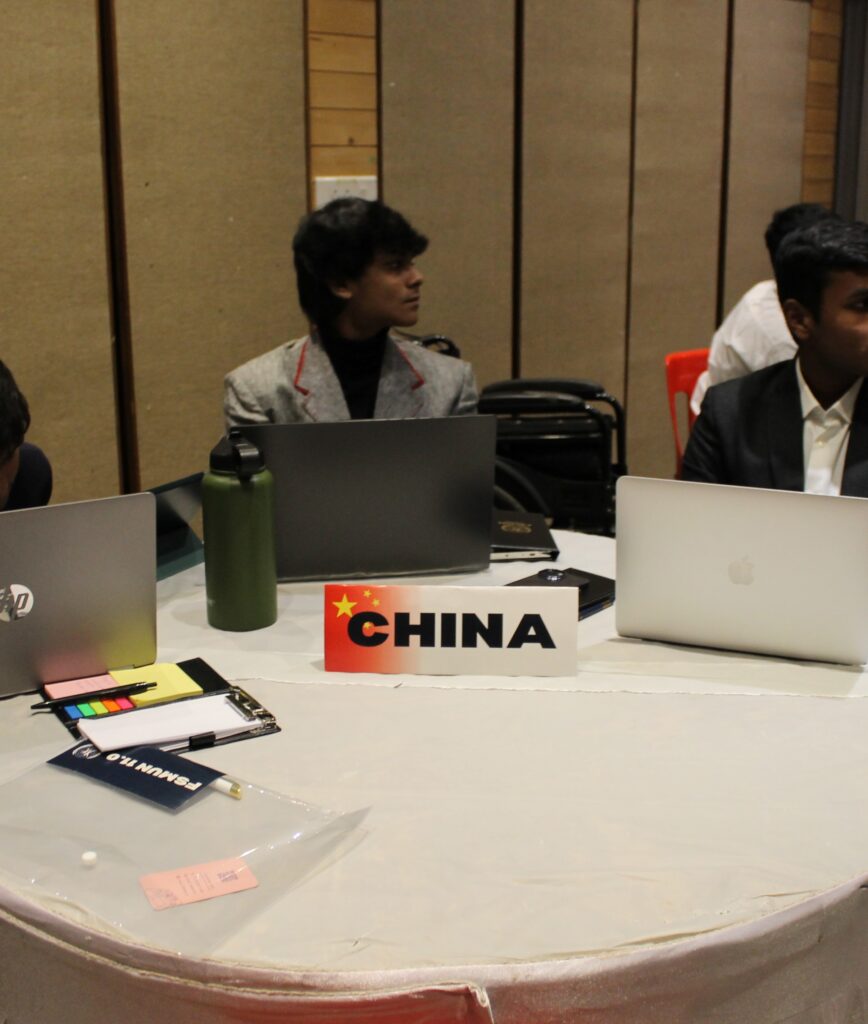
I participated as a delegate in FSMUN 11.0 which is the official 11th edition of Fountainhead school’s model united nations. My portfolio was a group delegation where I received the country China in the committee UNGA. My goals were to learn about and understand China’s position on international issues, convey its policies clearly, and participate in discussions to come up with resolutions. Working with other delegates, I wanted to improve my critical thinking, public speaking, communication, and diplomatic skills. I also wanted to get better at thinking strategically, finding solutions, and making a significant contribution to conversations about global issues.
LO1: Identify own strengths and develop areas for growth
I discovered that critical thinking and research are my strengths. I successfully analysed China’s position, structured my arguments, and confidently delivered them. However I came to the realisation that my weakness is teamwork in MUNs. Finding our weaknesses helps us to improve while recognising our strengths increases our confidence. In collaborative environments like MUNs or group projects, overcoming weaknesses is essential for improving performance and doing well. I am aware of the effects of teamwork now that I know this weakness. It has inspired me to work on enhancing my teamwork abilities and figuring out how to interact with group members more successfully in the future. Moreover, I will be preferring NOT to participate in a group delegation because although, you can handle yourselves, you will not always be able to manage others involved. Not everything will be in our hands and not working in a group delegation will just help me improve my own performance and make me win.
LO6: Demonstrate engagement with issues of global significance
The issue I engaged with in FSMUN 11.0 was the abolishment of veto powers in the UNSC. The P5 members, China, the United States, Russia, the United Kingdom, and France have the veto power which frequently keeps the UN from acting effectively on pressing international issues like wars and humanitarian disasters. This makes the topic globally significant. The veto power may hamper efforts to solve global issues like war and human rights abuses which have an impact on international peace and security. My perspective on global leadership and the significance of fair decision-making has grown as a result of my understanding of this system. My knowledge of diplomacy and international relations has grown as a result of learning about this topic. It inspired me to consider options seriously and helped me understand how difficult global decision making is. I became more mindful of and inspired to participate in these discussions further as because of my involvement in FSMUN which helped me understand the difficulties in finding a balance between national interests and international collaboration.
LO7: Recognize and consider the ethics of choices and actions
The abolition of veto powers was the main ethical issue. Fairness, equality, and global justice are ethical issues brought up by the P5 members’ veto authority. It gives a small number of nations excessive power which frequently hinders proper action on urgent global issues like conflicts and human rights abuses. How the current system offers a fair and democratic approach to international decision making was the main topic of discussion. Since I represented China, which supports preserving the veto system, the ethical issues had an indirect impact on me. I was divided about the fairness of a system where one nation might prevent significant resolutions even if I respected China’s position. I became more aware of the ethical issues between global responsibility and national sovereignty as a result of this. I didn’t fully understand the veto system’s moral impacts before, but I thought it was essential to preserving world peace. Afterwards, I became aware of the imbalance in power and the necessity of reform to make the UN more democratic and capable of addressing global issues. My perspective has changed and I believe that the abolition of the veto is as an important factor involved for an equitable international system.
In FSMUN 11.0, I developed Communicator, Thinker, and Knowledgeable attributes by representing China in the UNGA and debating the abolishment of veto powers. My studies in business management, where power dynamics and decision making are crucial are connected to this. By encouraging discussion about equity in global governance, the activity helped other people. Participating in discussions and acknowledging the necessity of UN reform was an important point. I started to advocate for more equal global decision making instead of supporting the veto system. I felt a sense of pride after successfully contributing to significant conversations. I want to keep promoting justice and moral decision making in society and I intend to use what I’ve learnt in next MUNs and academic activities.