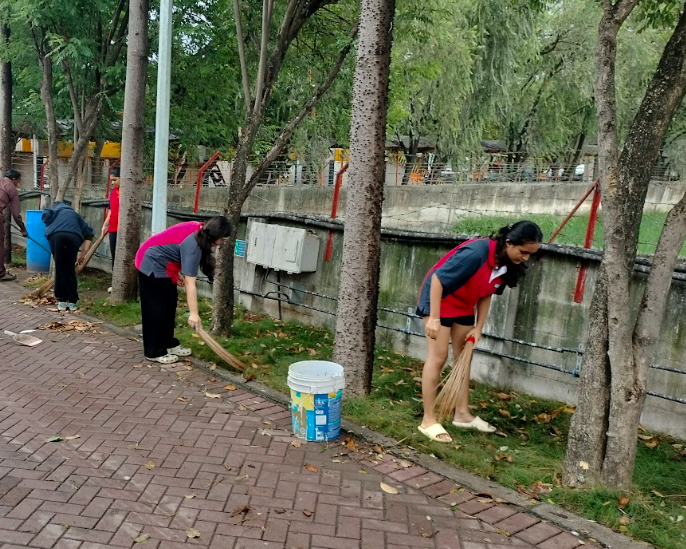
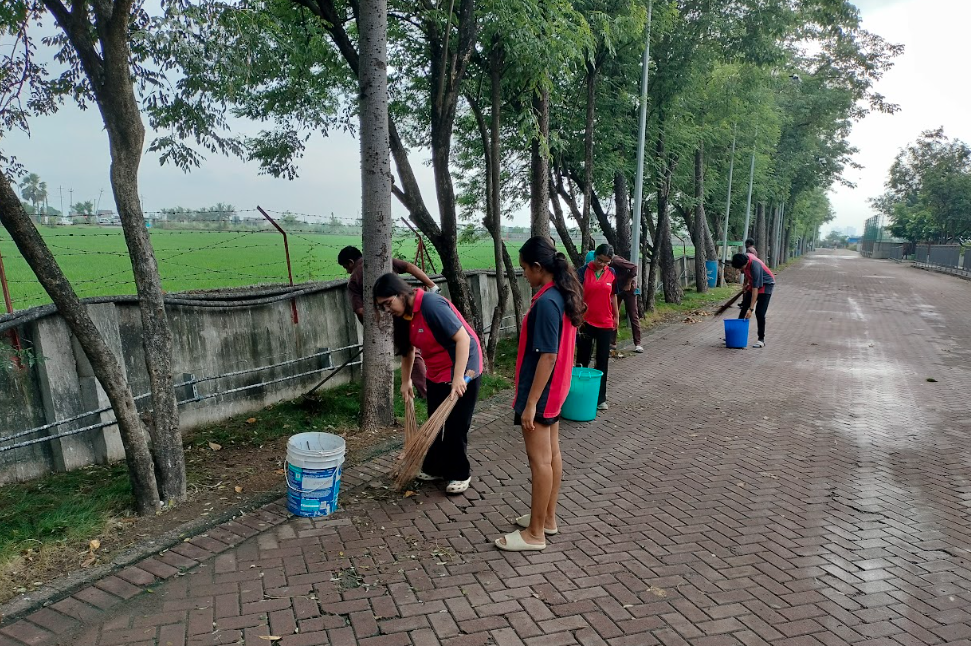
From August 18th to 20th, 2025, I participated in a school cleaning initiative where we collected dry leaves from around the school premises. What made this experience meaningful was that the collected leaves were not simply discarded but were later used to create organic fertilizer for our school garden. This CAS activity gave me the opportunity to contribute to a cleaner environment while also learning about the importance of sustainability and waste management.
LO5: Demonstrating Skills and Benefits of Working Collaboratively
Cleaning the school premises and collecting leaves required strong teamwork and coordination. We worked in groups to cover different areas of the campus, ensuring that every part of the school grounds was cleaned efficiently. This experience helped me understand the importance of cooperation and communication, as we had to distribute tasks, share equipment, and coordinate with one another to finish on time.
Working with others made the task not only faster but also more enjoyable. We motivated each other, and by the end of the activity, there was a shared sense of accomplishment knowing that our collective effort had made a visible difference. It reminded me that even seemingly simple tasks can have a greater impact when done collaboratively.
LO6: Engagement with Issues of Global Significance
This experience was closely linked to global environmental issues, particularly sustainability and waste management, which align with the UN Sustainable Development Goal 11: Sustainable Cities and Communities. Through this activity, I learned that dry leaves, when left unattended, can contribute to unnecessary waste, but when reused, they can become a valuable resource for making compost and fertilizer.
By turning the collected leaves into fertilizer, we contributed to reducing waste and promoting eco-friendly practices within our school community. It also helped me understand how small, local actions can have a positive impact on global sustainability goals. This experience made me more aware of how communities can contribute to a circular economy—reusing natural materials to create something beneficial rather than adding to environmental waste.
LO7: Recognising and Considering the Ethics of Choices and Actions
This CAS experience also taught me about the ethical responsibility we have towards our environment. Cleaning the school premises was more than just a physical task—it was an act of care and respect for the shared spaces we use every day. It reminded me that maintaining cleanliness and reducing waste are ethical duties that reflect responsibility and respect for the environment and others who share it.
Additionally, repurposing the collected leaves into fertilizer encouraged me to think about the long-term impact of sustainable actions. Instead of disposing of the leaves as waste, we transformed them into something useful that could nurture new plant growth. This ethical approach of recycling natural materials not only benefited the school but also promoted environmental awareness among students.