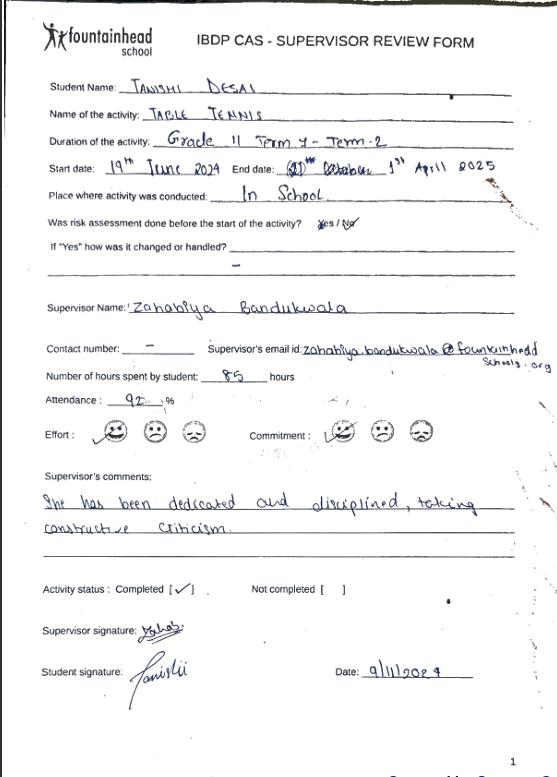
For my CAS Activity experience, I chose Table Tennis as my personal sport in Grade 11. I attended four training slots per cycle, which allowed me to engage in regular physical activity and develop both skill and discipline. Table tennis is a sport that requires precision, agility, focus, and strategy — qualities I aimed to strengthen through continuous practice. My purpose in choosing this activity was not only to improve my speed and agility but also to build consistency, resilience, and a healthier lifestyle alongside my academic journey.
This CAS experience provided me with an opportunity to set personal goals, track my progress, and reflect on my growth over time. Beyond developing athletic ability, I also learned about time management, dedication, and self-motivation, as regular training required commitment and perseverance. Table tennis allowed me to maintain physical well-being, reduce academic stress, and develop mental sharpness, making it a meaningful and balanced CAS experience.
LO2 – Demonstrate that challenges have been undertaken, developing new skills
When I began playing table tennis, I quickly realised that it was far more technically demanding than it appeared. One of the main challenges I faced was improving my hand–eye coordination and reaction time, especially during fast rallies. At first, I struggled to maintain control of the ball and often lost points due to poor timing and incorrect positioning. Another challenge was developing proper footwork, which is essential to reach shots quickly and return them with accuracy. I also found service techniques difficult to master, as they required precision, spin control and strategic placement.
To overcome these challenges, I had to step out of my comfort zone and consistently practise drills that targeted my weaknesses. I watched tutorials, asked for feedback from my coach, and repeated specific exercises like forehand-backhand transitions and serve returns to build muscle memory. Over time, I developed new skills such as spin control, rally consistency and better anticipation of my opponent’s moves. This experience taught me patience and resilience, as improvement did not come instantly but required consistent effort and a growth mindset. Taking on these challenges helped me gain confidence and made me more determined to refine my skills further
LO3 – Initiate and plan a CAS experience
Before starting this CAS experience, I set clear goals to guide my progress and stay motivated. My main aim was to improve my speed, agility and rally consistency in table tennis through regular and structured practice. To initiate this activity, I first discussed my interest with the school sports coordinator and enrolled in four table tennis training slots per cycle. I also created a simple plan outlining what I wanted to achieve each week, such as improving footwork, learning different spin techniques and increasing rally duration.
LO4 – Show perseverance and commitment in CAS experience
develop perseverance. Attending four training slots per cycle meant I had to manage my time effectively around academics and other commitments. There were times when progress felt slow—such as struggling to improve my footwork or mastering serves—but I remained committed to regular practice, understanding that skill development takes time and patience.
I also challenged myself by playing against peers with higher skill levels, which pushed me to adapt quickly and stay motivated even when I lost points or matches. By maintaining a disciplined routine, completing all planned drills, and continuously reflecting on my performance, I developed resilience, focus, and self-motivation. This experience taught me that perseverance is key to achieving both short-term improvements and long-term personal growth, reinforcing the value of staying committed even when tasks are challenging.
LO6 – Demonstrate engagement with issues of global significance
Through my table tennis CAS experience, I engaged with the broader issue of global health and well-being, which is increasingly important in today’s world where sedentary lifestyles and screen dependency are rising. By committing to regular physical activity, I not only improved my own fitness and mental focus but also became more aware of the importance of promoting healthy habits within my community. Participating in a structured sport like table tennis highlights how accessible physical activities can contribute to preventing lifestyle-related health problems and fostering overall well-being, which is a concern shared globally.
Additionally, I observed the social benefits of sports, such as encouraging teamwork, inclusion, and fair play, which are essential values in creating supportive and healthy communities. This experience made me reflect on how even small actions, like engaging consistently in sport, can contribute to wider societal health outcomes, reinforcing the idea that personal development and global well-being are interconnected.