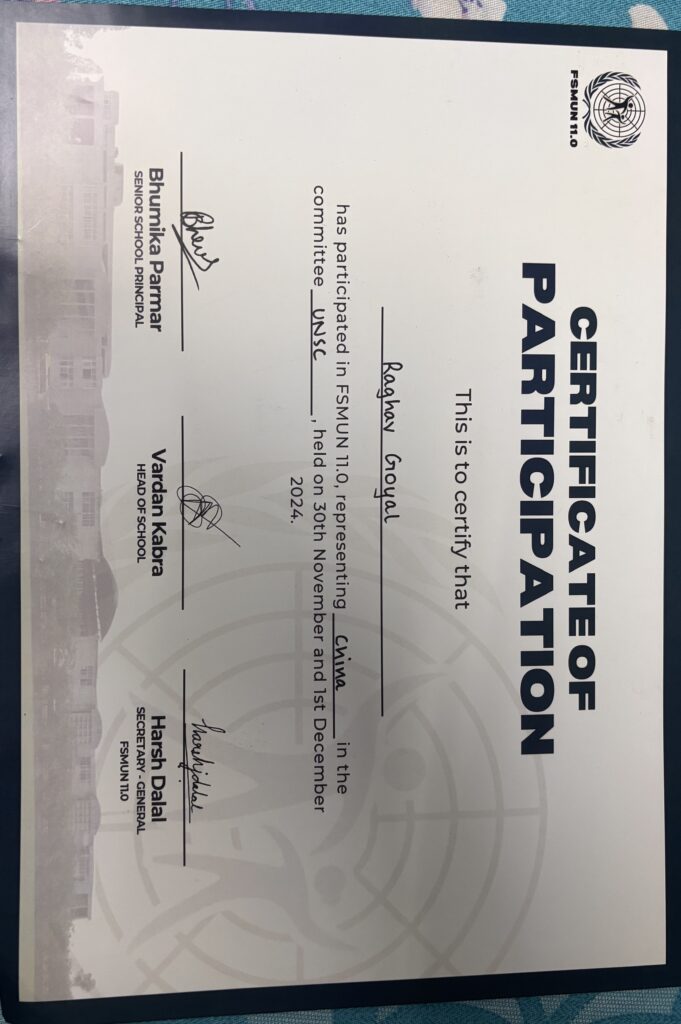
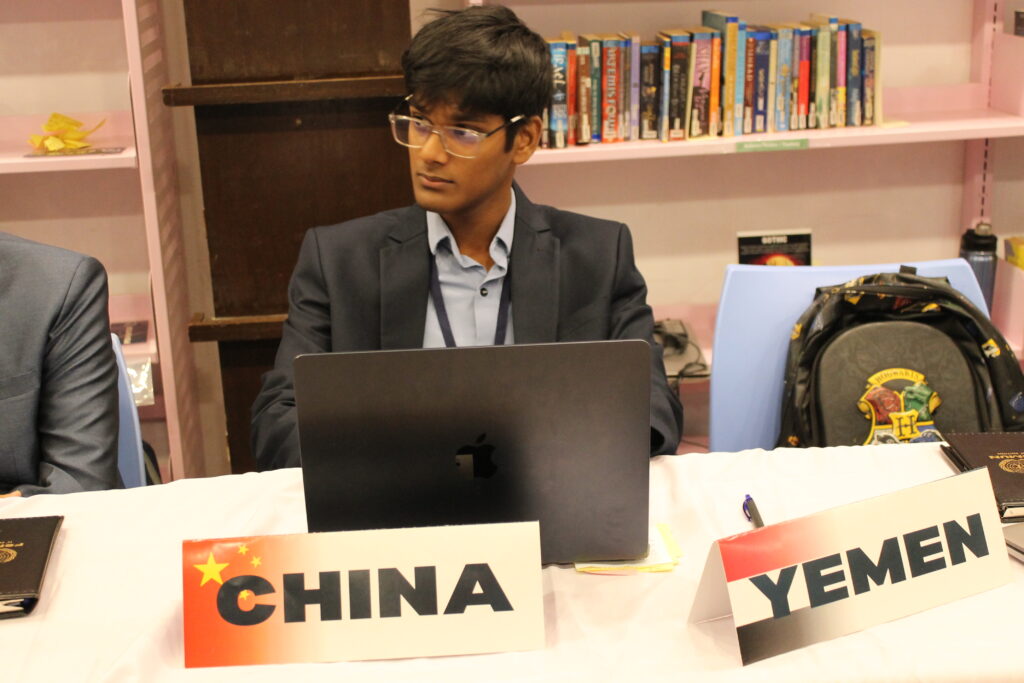
Participating in FSMUN 11.0 as a delegate of China in the United Nations Security Council (UNSC) was an intellectually stimulating and challenging experience. The conference focused on the pressing issue of the Israel-Palestine conflict, requiring delegates to engage in intense debates, propose resolutions, and navigate complex international diplomacy. Representing China, I had to adopt a strategic and balanced approach, ensuring my stance aligned with the country’s foreign policy while actively contributing to discussions on achieving sustainable peace. Through this experience, I enhance my critical thinking, negotiation, and public speaking skills, gaining valuable insights into global geopolitics and the workings of the UNSC.
LO5—Demonstrate skills and benefits of working collaboratively.
Strategic teamwork is an essential skill to be used inside an MUN. Even before the MUN starts we need to create a blog of allied nations on the topic. These allied nations help in gathering the simple majority, which is crucial to be able to pass a resolution. Furthermore, after the MUN had begun, you needed to continuously collaborate with your allies and discuss who was going to raise the motion. All in all, in an MUN, when working in a team, we get insights and inputs from other delegates and get a variety of ideas for things such as motions, draft resolutions, etc., which can be implied and target our enemies and even influence some neutral states.
LO6—Engagement with issues of global significance.
As a delegate of China in the United Nations Security Council (UNSC) at FSMUN 11.0, I actively engaged with the Israel-Palestine conflict, a globally significant issue with historical, political, and humanitarian implications. The conflict affects international peace, security, and diplomatic relations, making it a crucial topic for discussion. By representing China’s stance, I had to analyse geopolitical dynamics, historical context, and foreign policy considerations to contribute effectively to the debate. This experience deepened my understanding of global diplomacy, power struggles in international relations, and the role of the UNSC in conflict resolution. Additionally, I recognised the ethical dimensions of the issue, as decisions made by global powers significantly impact millions of lives. Engaging with this topic helped me appreciate the complexity of international negotiations and the responsibility of nations in maintaining global stability.
LO7—Recognise and consider the ethics of choices and actions.
As a delegate of China in the United Nations Security Council (UNSC) at FSMUN 11.0, I had to carefully consider the ethical implications of foreign policy decisions while debating the Israel-Palestine conflict. Representing a major global power required me to balance national interests with humanitarian concerns, ensuring that my arguments aligned with China’s diplomatic stance while also acknowledging the ethical responsibility of global leaders in conflict resolution. I had to navigate complex moral dilemmas, such as sovereignty vs. human rights, and evaluate how different policy choices could impact millions of lives. Additionally, I was mindful of the ethics of neutrality, bias, and diplomatic negotiations, as decisions made by international bodies like the UNSC directly influence peace efforts, humanitarian aid, and regional stability. This experience reinforced my understanding of ethical decision-making in global politics, highlighting the importance of diplomacy, responsibility, and fairness in addressing international conflicts.
To conclude, FSMUN has taught me various things, especially forcing me to leave my comfort zone and grow as a person not afraid to share his perspective in front of others. It has allowed me to grow my communication, critical thinking, and analytical skills and helped me become more confident in my points of view and research.