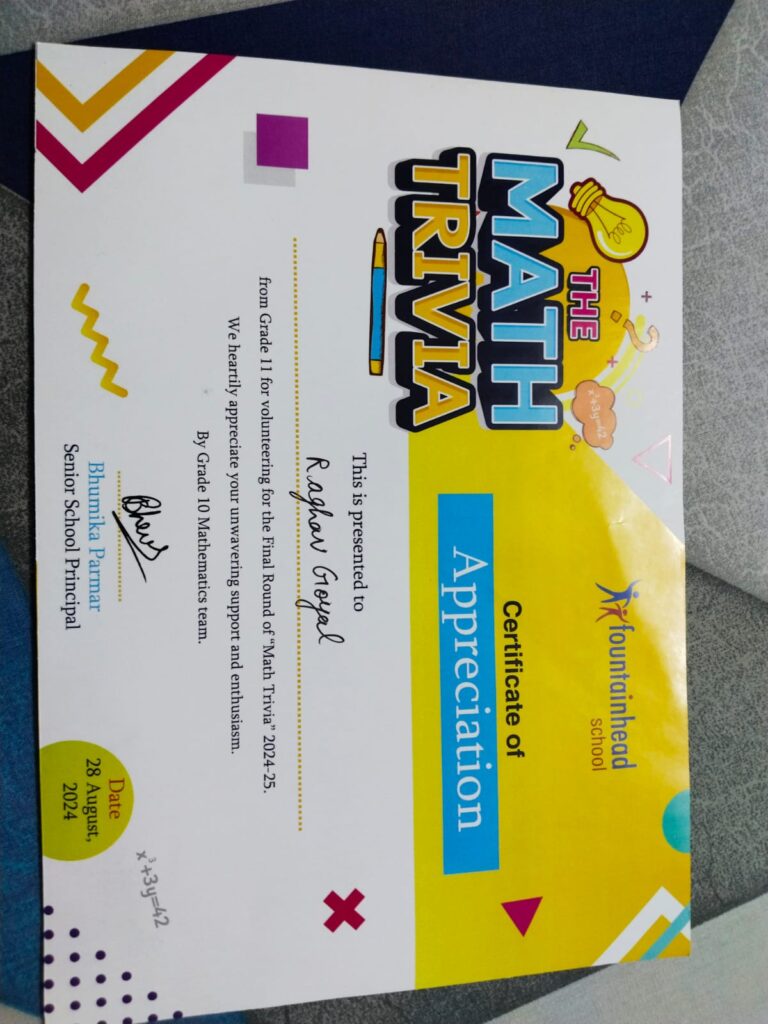
Throughout my life, mathematics has always been my favourite subject. This passion for the subject naturally led me to develop a high level of proficiency and consistently achieve excellent scores. With a strong track record in the subject up until grade 10, I was given the opportunity to lead and plan a math trivia event. When people think of organising a math trivia event, they often assume that all the organising committee has to do is use AI to copy-paste some challenging and complex questions into a presentation. However, planning a math trivia is much more challenging than that. The process involves determining the appropriate number of rounds and questions while considering the available time. We spent countless hours carefully deliberating on how the rounds would work and interact with each other. Moreover, we poured our heart and soul into crafting the questions to ensure that we avoid any kind of mistake that can occur on the day.
LO1 [Identify own strengths and develop areas for growth]
While we started developing the ppt after successfully distributing the task and responsibilities according to one’s strengths, we realised how difficult it is to balance off questions’ difficulty and make sure that every participating team gets a fair chance to win. One of the issues with developing a ppt was that it is very difficult to find or develop questions that are of the same topic and difficulty level but are different from each other. In other words every question needed to be unique with a common and same difficulty level in order to maintain the proper fairness of the trivia competition. There were many instances where many of my suggested questions would get rejected just because of repetition or being too difficult for the round. One area of growth I noticed was developing my critical thinking skills. I had to think critically and creatively while developing the questions. This forced me to think outside of the box and come up with new ideas to make each question unique and have a common difficulty level in each of the rounds decided.
LO2 [Demonstrate that challenges have been undertaken, developing new skills.]
The biggest challenge we faced while creating the PPT was identifying the appropriate questions to include in the trivia. When we started working on the PPT after discussing all the rounds and their formats, we realised how little we knew about how much our juniors had learned. Initially, we had no idea whether all the participants would be math-extended students or not, how much they might have covered in their curriculum by that time, or the level of difficulty they were exposed to. These uncertainties made it significantly challenging to balance the difficulty of the questions. Furthermore, there were instances when I thought I had found the perfect question for a round, only to have it rejected by the supervisor because the topic hadn’t been covered yet or because the question was too complex for the round’s format and time limit. By making changes to the questions and understanding the grade 10 math curriculum better, we were finally able to appropriately adjust the difficulty level of the selected questions.
LO3 [Initiate and plan a CAS experience]
As a group, we planned the entire event ourselves. The only information provided by our supervisor was the date, time, and location of the event. As a team, we initiated and executed the project according to our plan, keeping in mind the necessary deadlines. We brainstormed possible rounds, their specific rules, and different scenarios that could arise during the event, ensuring we were prepared to address them. On the day of the event, most things went as planned. However, the only aspect that took longer than anticipated was explaining the specific rules of the rounds to the participants. Overall, the event was a major success. We ensured that the audience remained engaged throughout the event by incorporating audience questions to maintain their interest.
LO4 [Show perseverance and commitment in CAS experience]
Many times while working on the CAS project, I feel like the deadline is 1 week, but it is not enough. As discussed above, the challenges faced while initiating and planning the event, finding the right questions, were even more difficult than any of us anticipated. Due to this we had to be completely committed to the task in hand in order to complete the preparation on time before the event. Without dedication and commitment, this CAS project would not have been achieved in the given time period and days before the main event.
LO5 [Demonstrate skills and benefits of working collaboratively]
Working collaboratively has a significant impact on the preparation of the event and organising. One of the benefits of working collaboratively was the different perspectives and ideas we were able to get on one decision. This allows us to sometimes double-check the questions, make quick revisions in rules or questions to scale the difficulty, and much more. Another benefit was that we were able to divide the workload on the basis of individual strengths and weaknesses. For example, one person was good at the circle theorem, so he focused on developing and finding out questions specific to the circle theorem only. This allowed us to evenly divide all of the topics while also making sure that everyone can provide their best.
LO7 {recognize and consider the ethics of choices and actions]
While planning the math trivia, we had to carefully consider the ethical responsibility of fairness to all participants. This meant ensuring that none of the questions gave an unfair advantage to students from a particular stream, or included topics that had not been covered in their curriculum yet. We also had to make sure that the rules were transparent and clearly explained to avoid confusion or bias. Moreover, we were conscious of avoiding plagiarism by creating and adapting our own original questions instead of copying them directly from online sources. These decisions highlighted the importance of ethics in organizing such events, as fairness, inclusivity, and honesty directly influenced the participants’ experience and the overall success of the trivia.
One skill that I demonstrated and improved on was my ability to put my points forward. This is mainly because organising this event was a timely process, and mainly all of the team members had a lot of brainstorming and debates to figure out the perfect solution and ideas for the round format. Hence, in these situations I displayed my ability to not only include the questions by explaining the importance of the question but also reach a consensus among the group without showing inappropriate behaviour.