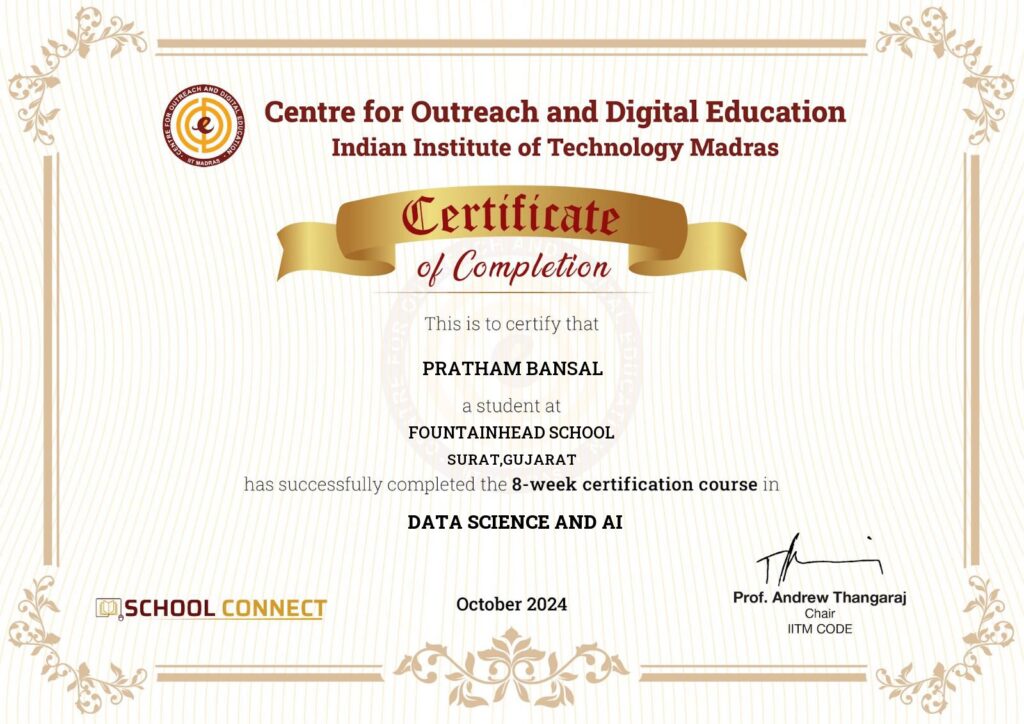
Modern technology experiences continuous evolution which means people must understand the fundamentals of Artificial Intelligence (AI) during the digital age. My effort to learn more about AI led me to enroll in an AI certification program. Through this experience I explored fundamental AI principles together with learning strategies and practical applications and encountered obstacles which I solved. This experience helped me develop essential skills along with showing determination.
LO 1 – Identify own strengths and develop areas for growth
The initial understanding of AI which I had previously acquired led me to pursue training in order to master the learning principles and practical uses of AI systems. My logical thinking abilities together with pattern recognition skills made it possible to learn both supervised and unsupervised learning methods. The component of feature engineering proved challenging to me particularly when working with unstructured information. I used this understanding to establish data preprocessing as a specific area for my skill improvement.
LO 2 – Demonstrate that challenges have been undertaken, developing new skills
The academic program proved difficult by demanding complete dedication of students. The complex idea of evaluating algorithm performance proved to be my toughest academic challenge. During the beginning I found it difficult to comprehend training errors together with performance measurement methods. Continuous practice with KNN and decision trees and neural networks together with reviewing these AI models helped me grow substantially in my abilities. The image classification task using pixel inputs served as crucial practical work that brought theoretical understanding closer to real-world practice.
LO 4 – Show perseverance and commitment in CAS experience
Students needed to invest both patience and commitment when learning about supervised and unsupervised learning along with sequential learning processes. The process required perseverance even during times when the K-means clustering and hierarchical clustering methods proved difficult to work with. I invested additional time to research alongside my peers and attempted the Iris dataset and vegetable market expenditure data using different methods. I reached my objective by implementing AI learning approaches to solve practical problems which included creating question-answering systems and healthcare solutions.
Conclusion
This course has strengthened both my problem-solving abilities and my technical expertise to a great extent. I possess greater comfort in using AI principles for practical applications and product developments. My educational experience has taught me about unyielding commitment and ongoing learning that I will use throughout university studies and future work life.