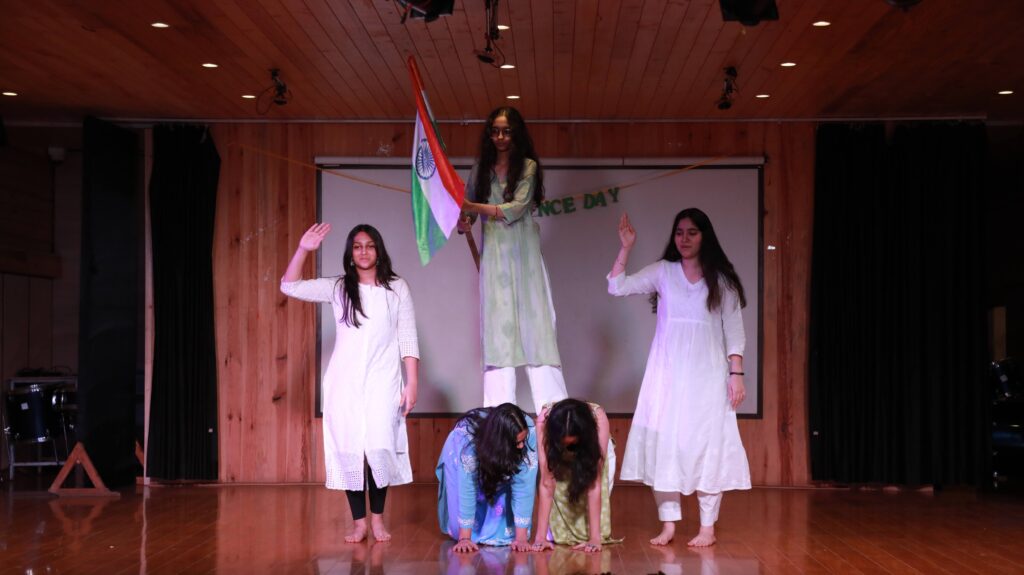
The 76th Independence Day was witness to a magnificent show of creativity from school students across all grades, adorned in traditional clothes and patriotic love. This time, me and my group of friends were a part of the performers rather than the audience, with a dance prepared entirely by ourselves.
LO3: Demonstrate how to initiate and plan a CAS experience
This CAS activity was completely student-driven and organized by our group. As a lot of my friends love dancing, I also decided to join them and learn why it was so much fun. In celebration of India’s 76th Independence Day, we collectively choreographed and presented a five-minute dance routine through a medley of five patriotic songs.
The choreography process was quite interactive and included the creative contribution of every member. We spent a lot of time brainstorming, organizing, and perfecting the dance steps and also finalizing song and their transition to make it a cohesive and effective performance. In order to follow our timeline and present the best possible performance, we often met at one another’s homes for rehearsals, carefully perfecting our routine.
Our preparation was structured, with every detail of the performance—song choice, order, synchronization, and delivery—thoroughly planned. The end product was a patriotic and beautiful dance that we delivered twice during the celebration day. This activity not only made me appreciate dance more but also improved my teamwork and time management skills.
LO5: Demonstrate the skills and recognize the benefits of working collaboratively.
During the preparation of our dance, as aforementioned, all of us contributed toward the song choice as well as the choreography. Without the help of one another and our individual creative forces at work to make the dance as good as possible, it would’ve taken a lot of time and effort for a single person to do the task that we had done together. However, working collaboratively was not always easy and required strong communication skills. We sometimes had conflicting ideas, and everybody had to compromise and think through the others point of view in order to see and understand their vision.
Along with that, we had to change steps that some of us couldn’t do due to their lack of professional prowess in that field, which was usually me since it was my first time dancing for a performance. Nonetheless, we all tried to create a final dance that was inclusive to the ideas and abilities of everyone, showcasing how working together helped us learn to be more considerate of others, value other perspectives, while also reinforcing the idea that by working together, we can achieve what may be impossible alone.