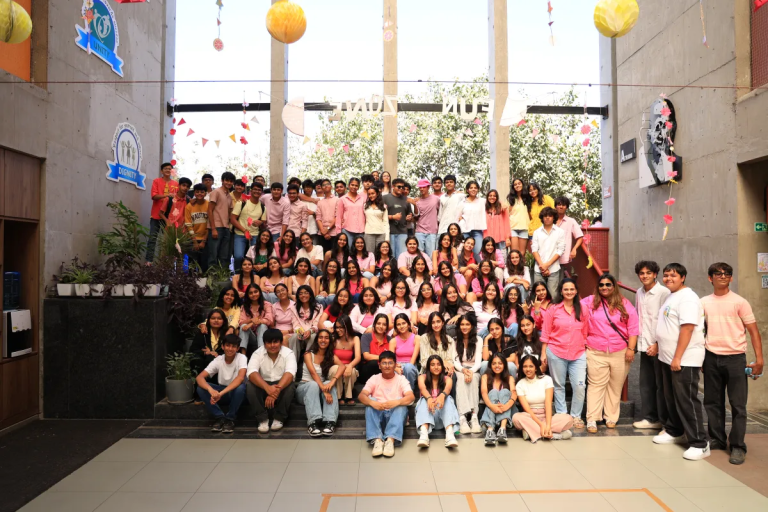
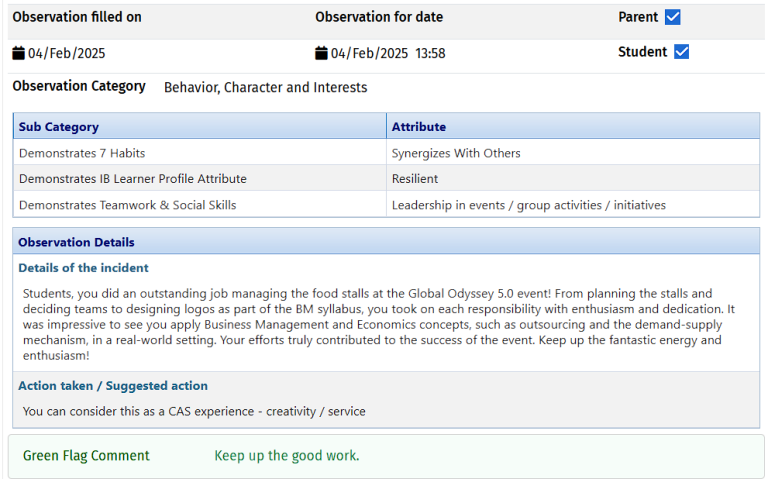
During my CAS Service Experience, I collaborated with three peers to organize a food stall at Global Odyssey 5.0, an event organized by the Business Management and Economics students. This food stall involved managing a budget, sourcing supplies, preparing items, establishing fair, but profitable prices, and operating throughout the day. Though this was primarily a business experience, it turned into a learning experience blending creativity, service delivery, and collaboration. I came away with hands-on experiences in business strategies, marketing, and teamwork, which I found both educational and enjoyable.
LO3 – Initiate and plan a CAS experience
From the outset, the experience of initiating the cookery demonstration required planning and organization. My classmates and I worked together to develop a menu that was economical, appetizing, and uncomplicated to execute in a school context. Once we developed the menu, we assigned tasks: some people were responsible for obtaining the ingredients while others outlined the budget and suggested packaging and pricing considerations. There was even a ‘shopping list’ of ingredients and cooking equipment/hygiene items (e.g. gloves, tissues). In preparation, we even conducted a small trial at home so we could test portion sizes and cooking times. This was the stage where I discovered how beneficial it is to anticipate problems and be organized when ‘scaling-up’ to serve a larger number of people. I came to the realization that initiating and planning are just as vital as carrying out the cookery demonstration itself.
LO5 – Demonstrate skills and benefits of working collaboratively
At our stall, collaboration was key to success. When demands for vadapav surged unexpectedly, the team member cooking started to feel overwhelmed. Without hesitation, two of us jumped in, one to prep vadapav and the other to package them, while the fourth took care of customers and menu items. This impromptu collaboration showcased our willingness to adapt and support each other, even if it meant adjusting and diverging from our roles. The situation was a general reminder that being flexible, working as a team, and communicating with each other is important when dealing with busy environments while trying to achieve the same goal.
LO6 – Demonstrate engagement with issues of global significance
The stall might have been established in the context of a business activity, but it also connected with an issue of global concern, which is Zero Hunger (SDG 2). The process of preparing and serving food helped me understand more about how access to food, which many of us take for granted, is a need for millions around the world. As a team we sought to minimize waste by thinking about portion sizes and my team members and I worked to re-utilize packaging when possible. While this may seem meager, it was a conscious decision and it drew attention to the notion that simple, everyday choices are connected to larger world issues, such as sustainability and food security. It also reinforced the notion that food is not simply an exchange commodity, but a fundamental human right.
Conclusion
Taking part as a volunteer with Global Odyssey 5.0 was an experience full of difficulties and growth. The majority of my role was to plan and create the stall we operated, to adapt to the pressure of this experience, and to grow from both my failures and successes. Ultimately, I developed valuable skills, such as teamwork, interpersonal communication, problem-solving, time management, and demonstrated the value of working together. At the same time, this experience contributed to my expanded awareness of issues facing the world, such as food security, and demonstrated the connection between the local community and global issues. Overall, this was a CAS experience that helped further the understanding of real-world learning and helped me further develop my organisational and collaborative skills, while reflecting on my responsibility and sustainability in making everyday choices.