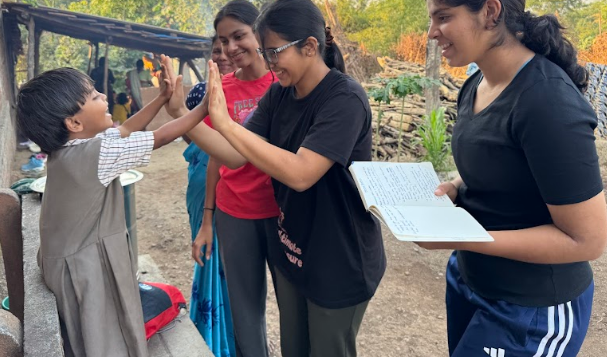
My visit to Mokhmal, a village community in Dang, was one of the most eye-opening CAS experiences I have had. We stayed there for a week, immersing ourselves in the daily lives of the villagers while simultaneously observing the many difficulties they faced, such as lack of water, limited access to healthcare, and the absence of basic services like banks. During our stay, we engaged in different activities such as trekking, visiting local schools and hospitals, watching traditional folk dances and music, and directly contributing by cooking a meal for the community and donating books and sports equipment to children. This trip was not only about service but also about understanding and empathizing with people whose lives are very different from our own. It also connected with our Group 4 project, where we designed possible solutions to address some of the systemic challenges villagers encounter.
LO1 – Identify own strengths and develop areas for growth
During this trip, I discovered that one of my strengths lies in adaptability. Living in an environment so different from my usual lifestyle required me to adjust quickly to limited resources and new conditions. I found myself open to new experiences such as cooking in bulk for the community or trekking through challenging terrain. I also realised that I could connect with people across language and cultural barriers through empathy and active listening. I also understood how I can easily mould myself in conditions that are new to me. This was because the experience warranted me to immerse myself into greenery and also live in rooms and accommodations I don’t usually prefer. I saw myself adapting and not complaining which helped me discover this attribute in me.
At the same time, I became aware of areas for growth. While I was able to adapt, I sometimes felt overwhelmed when observing the scale of the villagers’ problems, such as inadequate healthcare or water shortages. I realized I needed to build more resilience and problem-solving ability in such contexts so that instead of only empathizing, I could also think critically about practical solutions. This experience therefore highlighted both my capabilities and the skills I must strengthen further.
LO2 – Demonstrate that challenges have been undertaken, developing new skills
The trip was filled with challenges that tested me both physically and emotionally. Simple activities like trekking through forested trails in unfamiliar terrain or cooking food for large groups required me to step outside my comfort zone. Additionally, interacting with villagers and understanding their hardships forced me to confront realities that were very different from my own privileged life.
Through these challenges, I developed new skills. For example, cooking at scale demanded teamwork, time management, and efficiency, while donation activities required coordination and sensitivity in distribution. On the academic side, linking our Group 4 project to the villagers’ problems taught me how to apply scientific knowledge to real-world issues. The skills I gained will continue to serve me beyond this one experience.
LO3 – Initiate and Plan a CAS Experience
The Group 4 project we undertook during our trip to Mokhmal gave me the opportunity to experience firsthand what it means to initiate and plan a CAS experience from scratch. Our starting point was identifying the main issues faced by the villagers such as water scarcity, inadequate healthcare, and lack of access to basic facilities like banks. Rather than simply discussing these problems abstractly, we decided to channel our project into designing potential solutions that could have a real impact on their lives. This required a great deal of planning, as we had to define our objectives clearly, assign responsibilities among group members, and align our work with the resources and time we had available during the trip.
In the planning stage, I contributed by helping brainstorm feasible ideas that connected with the villagers’ reality. For example, while large-scale infrastructural solutions were unrealistic, we explored smaller, practical interventions such as low-cost water filtration methods and ways of improving hygiene awareness. I learned the importance of setting achievable goals and breaking down the project into manageable steps. Planning also meant coordinating with my peers from different subject backgrounds, ensuring that our scientific, social, and creative perspectives blended together to form coherent solutions. This process taught me how structured planning and thoughtful initiation are key to turning ideas into meaningful outcomes. We made a rice dehusker for them which was a device that was portable in context to the size of their homes.
LO4 – Show perseverance and commitment in CAS experience
The week-long stay was demanding in many ways. Living in simple conditions without access to many comforts tested my perseverance. Despite the initial discomfort, I committed myself fully to the program, whether it was participating in long treks, working on the Group 4 project, or serving the community through meals and donations. I reminded myself that my temporary inconvenience was nothing compared to the daily struggles faced by the villagers. I learned to look at things with perspective and understood that not everything is objective if I think it is.
My perseverance was especially important during community service activities. Cooking a meal for an entire village, for example, was time-consuming and required sustained energy. I could have stepped back, but I chose to remain engaged and contribute until the end. This commitment not only made me more resilient but also ensured that my contribution had a real impact.
LO5 – Demonstrate skills and benefits of working collaboratively
The success of our trip rested heavily on collaboration. From organizing donation drives to dividing responsibilities during cooking, we worked as a team to ensure everything was done smoothly. Each member contributed differently wherein some focused on preparing food, while others handled sports equipment or book donations. I also demonstrated my communication skills as I was able to talk and spend time with the little girls at the school we visited. I saw myself talking to them and understanding them which was very worthwhile.
Collaboration also played a role in the Group 4 project. We brought together different disciplines including science, design, and social studies in order to propose solutions for the villagers’ problems. This interdisciplinary teamwork broadened my perspective and showed me the benefits of collective problem-solving. Working collaboratively also strengthened my communication skills, as I had to listen to others, share my thoughts clearly, and adapt my approach for the benefit of the group.
LO6 – Engagement with issues of global significance
The problems we observed in Mokhmal were not isolated since they represented issues of global significance. Lack of clean water, inadequate healthcare, and limited access to essential services are the few challenges faced by millions worldwide. Witnessing these problems firsthand helped me understand that global issues like inequality, poverty, and sustainable development are not abstract in fact, they affect real people in very immediate ways.
Our Group 4 project allowed us to engage directly with these global issues. By analyzing the villagers’ difficulties and proposing solutions, we were not just acknowledging the problems but actively trying to contribute ideas toward change. This experience deepened my understanding of global development goals and my responsibility as a global citizen to engage with these pressing challenges.
LO7 – Recognise and consider the ethics of choices and actions
Serving the Mokhmal community also required ethical consideration. For example, while donating books and sports equipment, we had to ensure fairness so that no child felt excluded. Similarly, when cooking meals, it was important to prepare food that was respectful of their culture and dietary habits. These decisions reminded me that service is not only about giving but also about giving responsibly.
Ethics also played a role in how we approached the villagers’ problems. It would have been easy to make assumptions about what they needed, but we learned to listen and observe instead of imposing our own ideas. This humility and ethical awareness helped us recognize that meaningful solutions must respect the dignity and agency of the community itself.
In conclusion, the week in Mokhmal was a transformative experience that combined service, cultural immersion, and academic application. It allowed me to discover my strengths in adaptability and empathy, while also highlighting areas where I need growth, such as resilience in problem-solving. By facing physical and emotional challenges, I developed new skills and learned the importance of perseverance. The collaborative nature of the trip showed me how teamwork enhances impact, while the villagers’ struggles helped me engage with global issues of inequality and sustainability.