
I recently had the opportunity to go on a rural immersion trip to Dang, a region I had only heard about but never really imagined visiting. This experience allowed me to see a very different way of life, and helped me understand some of the challenges that people in rural areas face on a daily basis. We visited farms, a local hospital, a milk processing factory, and interacted with many members of the local community. Each part of the trip gave me something new to think about.
LO1 – Identify own strengths and develop areas for growth
One thing I noticed during the trip was that I was able to observe and understand things around me quite well. I tried to be fully present in each place we visited, whether it was listening to farmers explain how they work or seeing the limited facilities in the hospital. At the same time, I realised that I sometimes hesitate to ask questions or start conversations, especially when I feel out of place. This is something I want to work on, because I know asking the right questions is important for learning more deeply.
LO2 – Demonstrate that challenges have been undertaken, developing new skills
Spending time in a rural environment wasn’t always easy. The living conditions were basic, and we had to adjust to a different routine. But those challenges taught me a lot. I developed more patience and flexibility. I also learned about rural sustainability methods, how local businesses like the milk factory operate, and I even tried a new art form. We created paintings using a local tribal style, and even though I’ve never really considered myself artistic, I slowly started to enjoy it and improved by watching others.
LO4 – Show perseverance and commitment in CAS experience
There were definitely moments when I felt tired or a bit overwhelmed, especially after full days in the heat or walking long distances. But I stayed committed to participating fully, whether it was during the early morning farm visits or the painting sessions in the evenings. I didn’t want to miss anything, and I think that helped me make the most of the experience.
LO5 – Demonstrate skills and benefits of working collaboratively
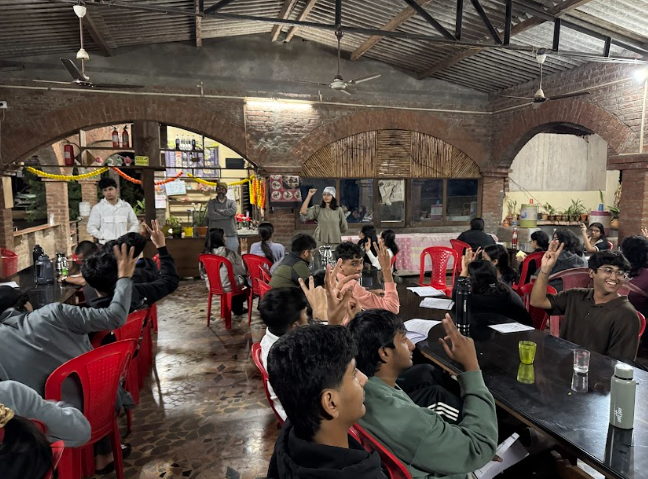
During the art sessions, we worked together as a group to plan and complete our paintings. It wasn’t always smooth—sometimes our ideas clashed or things didn’t come out as expected—but we supported each other and managed to create something we were all proud of. It reminded me how important collaboration is, especially when you’re working on something unfamiliar.
LO6 – Engagement with issues of global significance
This trip made me think deeply about global issues like environmental sustainability and access to education. On the farms, I saw how the locals use natural methods to grow food, often out of necessity but also with care for the environment. I also spoke to a few children and learned how difficult it can be for them to attend school regularly due to distance or family responsibilities. These are problems that exist in many parts of the world, and seeing them in person helped me understand their real impact.
LO7 – Recognise and consider the ethics of choices and actions
Being there made me reflect on the inequality between urban and rural areas. It made me realise how often city life takes for granted things like healthcare, education, or even transportation. It also made me think about how important it is to support systems and policies that reduce these gaps. Ethical action isn’t always about big decisions—it can be about what we choose to care about and how we act in everyday life.