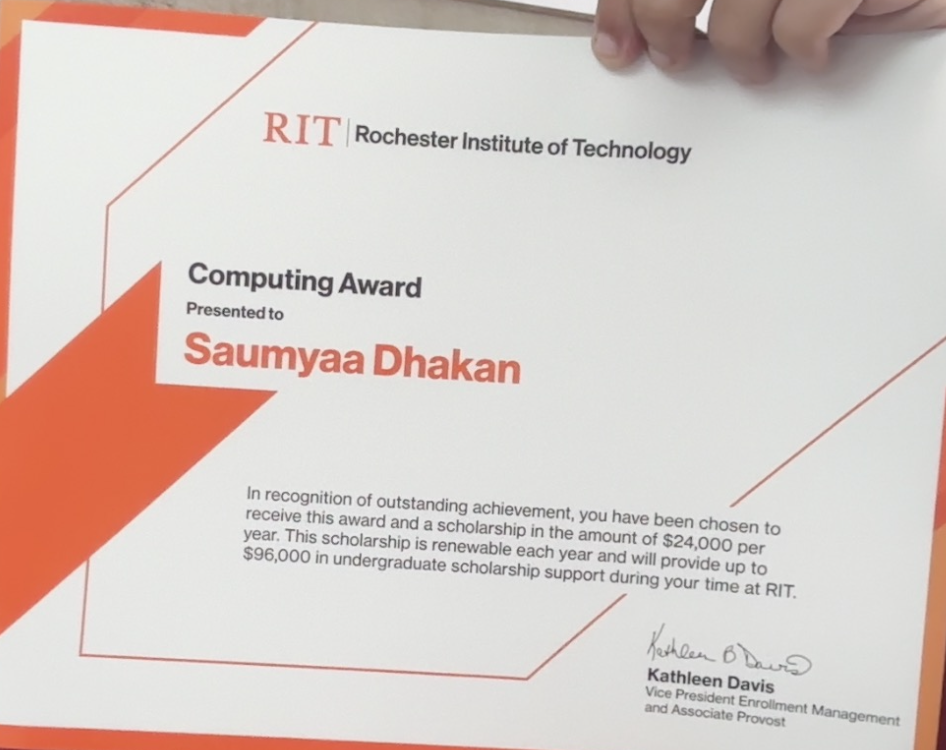
The process leading to the RIT Computing Award was shaped by my consistent engagement with computing through schoolwork, personal projects, and internships. I began by exploring programming and web development, later applying these skills in practical contexts such as building an e-commerce website for a family business. I expanded my creativity by experimenting with AI-based solutions and strengthened collaboration skills while working on professional development teams during internships. These experiences not only deepened my knowledge but also highlighted my passion for innovation in computing. Recognizing this journey, my school counselling team, led by Ms. Ritu Khanna, nominated me for the award, and I was honored when the Rochester Institute of Technology selected me as a recipient, granting a scholarship opportunity worth up to $96,000 over four years.
CAS Learning Outcomes
LO2: Demonstrate that challenges have been undertaken, developing new skills in the process.
While working on projects like building the e-commerce website and AI-based applications, I faced challenges in coding, debugging, and handling user needs. Overcoming these difficulties helped me develop stronger programming, analytical, and problem-solving skills, which ultimately contributed to being recognized for this award.
LO3: Demonstrate how to initiate and plan a CAS experience.
For each computing project, I had to plan thoroughly — identifying goals (e.g., helping a small business go online), setting deadlines, and structuring tasks. My ability to organize and lead these initiatives shows how I can initiate and execute long-term projects effectively.
LO4: Show commitment to and perseverance in CAS experiences.
Balancing school, internships, and personal projects required consistent effort and perseverance. Whether spending hours debugging code or learning new frameworks, I showed dedication to seeing projects through to completion, which demonstrates my resilience.
LO5: Demonstrate the skills and recognize the benefits of working collaboratively.
During internships and group-based projects, I collaborated with other developers, mentors, and even clients. I learned how teamwork leads to better solutions, and how important it is to listen, adapt, and contribute to a shared vision.
LO6: Demonstrate engagement with issues of global significance.
Technology and computing play a central role in addressing global challenges — from accessibility to sustainability. By building tech solutions (like AI applications and online platforms), I’ve engaged in creating tools that contribute, in small but meaningful ways, to broader global issues such as economic opportunity, digital inclusion, and innovation.
LO7: Recognize and consider the ethics of choices and actions.
Working with computing also requires an awareness of ethics — whether it’s ensuring privacy in AI systems, avoiding plagiarism in coding, or designing technology that benefits communities fairly. Winning this award reminds me that recognition comes with responsibility: to apply my skills thoughtfully and ethically.
CREATIVITY: This award recognizes my ability to think creatively with technology — not just coding, but designing innovative solutions to real problems. From developing an e-commerce website to experimenting with AI-powered applications, I applied imagination, originality, and critical thinking to create projects that extend beyond the classroom. Creativity in computing lies in finding new ways to approach challenges, designing systems that are both functional and impactful, and using technology as a medium of expression and innovation. Winning the RIT Computing Award highlights how my creative engagement in computing has been acknowledged at an international level.