(Collaborative Science Project)

Under my CAS project, I organised the Collaborative Science Event, the one such event at my school, which was intent on making science more interactive, engaging, and fun for students. As the organiser, my responsibilities went beyond planning and were heavy on the coordination, resource management, and execution of different science activities. It was up to me to create an enriching environment that encouraged curiosity and acceptance of hands-on learning. The project was meant to fill that gap between theory and practice where students explored science outside the confines of a textbook. Leading the CSP, the LO’s are as follows:
LO1 – Identify own strengths and develop areas for growth
Organising the Collaborative Science Project was a challenging yet rewarding experience that allowed me to reflect on my strengths and identify areas for growth. Throughout the process, I realised that my ability to plan and organise events was one of my key strengths. From creating detailed layouts to designing placards and posters, I was able to structure the event effectively and ensure everything was well-coordinated. My attention to detail and problem-solving skills helped me anticipate potential challenges and find solutions quickly, making the event run smoothly. However, this project also highlighted areas where I could improve. One of the biggest challenges I faced was time management. Balancing my CAS responsibilities with my academic workload required me to improve my ability to prioritise tasks and work under pressure. Additionally, while I was comfortable working independently, I realised I needed to develop stronger delegation skills. Initially, I took on multiple responsibilities, but as the project progressed, I learned to trust my team and distribute tasks more effectively. This experience taught me that collaboration and communication are just as important as individual effort in executing a successful project.
During this CAS experience, I was able to refine my strengths while also working on my weaknesses. The project pushed me to become more adaptable, improve my leadership skills, and develop a more structured approach to managing responsibilities.
LO2 – Demonstrate that challenges have been undertaken, developing new skills
Organising the Collaborative Science Project was not without its challenges, and overcoming them required adaptability, problem-solving, and resilience. One of the biggest difficulties I faced was managing multiple responsibilities simultaneously. I had to juggle several tasks while ensuring that everything was completed on time. This pushed me to improve my time management and multitasking skills, as I had to prioritise tasks efficiently while balancing my academic workload. Another challenge was handling last-minute changes. Whether it was adjusting the layout due to space constraints or making modifications to the materials provided, I had to think quickly and adapt to unexpected situations. Initially, these challenges felt overwhelming, but as the project progressed, I learned to stay calm under pressure and develop a more flexible approach to problem-solving. Additionally, I had to improve my communication and leadership skills. As the organizer, I needed to coordinate with different people, including teachers and fellow students, to ensure that every aspect of the project aligned with the initial plan. At first, I found it challenging to delegate tasks effectively, but through this experience, I learned the importance of trusting my team and distributing responsibilities to ensure efficiency. Through these challenges, I developed valuable skills that will benefit me beyond this project. I became more confident in my ability to lead, make quick decisions, and manage unexpected setbacks. This experience showed me that challenges are growth opportunities, and with perseverance and adaptability, I can successfully navigate complex situations.
LO3 – Initiate and plan a CAS experience
One of the most essential points in my CAS project is the planning and preparation phase. I had the enormous task of organising and implementing the Collaborative Science Project, so every detail of the project had to be well thought through to offer a smooth and engaging experience for participants. From concept brainstorming to the laying of the final block, I fashioned the very centre of the architecture of the event: dividing responsibilities and setting objectivity. I was made responsible for designing, cutting and folding the placards to mark different stations for experiments so participants could find their way easily among the activities. I also had to consider the preparation of the layout practically: where are the classes, and in which class the participants are supposed to be. Also, posters were made. Handling every matter with a mentor’s precision created an interactive and organised project that could pull the students into the nuances of science. Through this, I grew in organising skills and learned how important planning is for a large-scale event. The efforts eventually paid off when I saw the project becoming real and witnessed an effect on its participants.

LO4 – Show perseverance and commitment in CAS experience
Organising the Collaborative Science Project was not a one-day task—it required consistent effort, problem-solving, and dedication over an extended period. From the initial planning stages to the final execution, I had to remain committed to ensuring the event’s success, even when faced with various obstacles. The best of them has been having many elements to manage at the same time. Some other things I have to do include placard designing, working on an effective layout, and lastly, preparing a promotional poster. While juggling heavy academic responsibilities and other commitments, I found it challenging to complete all tasks on time, but I still did it. There were some difficult times during which things did not go according to plan-layout modifications had to be made at the last moment due to sudden changes in logistics that needed quick thinking. Most importantly, I maintained an adaptable attitude and constant problem-finding rather than discouragement. Another Real Test of Persistence was bringing all those involved in the project together. Effective communication with teachers, students, and participants will take a lot of patience and organisation.
LO5 – Demonstrate skills and benefits of working collaboratively.
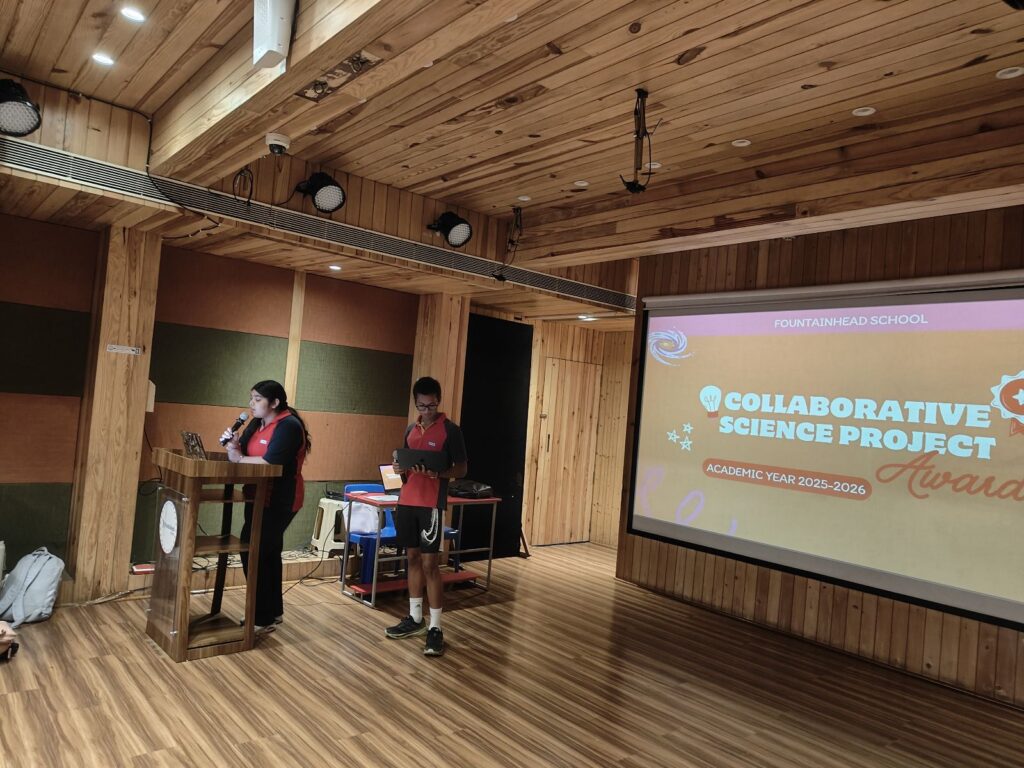
Organising the Collaborative Science Project was not a solo effort—it required working closely with teachers and my teammates to ensure the event was successful. Through this experience, I realised the importance of teamwork, communication, and coordination in executing an important project. One of my key responsibilities was ensuring that aspects of the event, from setting up stations to creating designs such as placards and layout posters, were carried out efficiently. This required constant collaboration with teachers, who guided me on how to and what to include in my work and helped in arranging materials. Working with them allowed me to refine the structure of the project and ensure that the activities were both educational and engaging. Additionally, I had to coordinate with my teammate to divide tasks effectively. We created an anchoring script for the award distributions and practised hard so that the ceremony would function smoothly. Whether it was setting up the venue, organising materials, or handling last-minute adjustments, teamwork played a crucial role in overcoming challenges. I learned that clear communication and delegation of tasks were essential to prevent confusion and ensure that everything ran smoothly. By trusting my team members and valuing their contributions, we were able to create an interactive and well-organized event. Through this project, I gained a deeper appreciation for the power of collaboration. I realised that working together not only makes tasks more manageable but also fosters creativity and efficiency. This experience has reinforced my ability to work as part of a team, a skill that will be invaluable in both academic and professional settings.

LO6 – Engagement with issues of global significance
The Collaborative Science Project was more than just an interactive learning experience—it was a step towards promoting scientific literacy and making education more engaging, both of which are issues of global significance. In today’s world, science plays a crucial role in addressing major global challenges, such as climate change, technological advancements, and medical breakthroughs. By organising this project, I aimed to encourage curiosity and critical thinking among students, helping them understand how science connects to real-world problems. One key issue that this project addressed was the accessibility of scientific knowledge. In many parts of the world, students do not have access to hands-on learning opportunities, making it harder for them to develop a deep understanding of scientific concepts. Through this project, I was able to create an environment where students could interact with science beyond textbooks, fostering a more engaging and practical learning experience. By making science more approachable and enjoyable, we contributed to the broader goal of improving STEM education and inspiring future problem-solvers. Additionally, science and collaboration are at the heart of solving global challenges. The project encouraged teamwork, communication, and shared learning—skills that are essential in addressing worldwide scientific issues. From climate action to healthcare innovations, international collaboration is crucial in advancing scientific progress. By facilitating a collaborative learning experience, I was able to reinforce the idea that knowledge grows through shared experiences and cooperation. This CAS project made me realise that even small initiatives within a school setting can contribute to larger global goals. By fostering curiosity and a love for science, we are ultimately contributing to a more informed and scientifically aware generation, which is essential for tackling the world’s biggest challenges.
LO7 – Recognise and consider the ethics of choices and actions
While organising the Collaborative Science Project, I had to ensure that all choices and actions aligned with ethical principles, including fairness, safety, and inclusivity. Ethics in science is not just about research integrity—it also applies to how scientific knowledge is shared and how learning environments are created. One of the key ethical considerations was ensuring inclusivity and equal participation. Science should be accessible to everyone, regardless of their background or prior knowledge. While planning the project, I made sure that the activities and explanations were engaging for all students, including those who may not have had a strong interest in science before. By designing interactive stations with clear instructions and visual aids, I aimed to make the experience welcoming and educational for everyone. Another major responsibility was maintaining accuracy and reliability in the scientific information presented. Since science is based on facts and evidence, it was essential to ensure that all experiments and demonstrations were conducted properly and that the explanations given were correct. Misrepresenting scientific concepts, even unintentionally, could lead to misunderstandings, so I double-checked information and consulted teachers when needed to ensure accuracy. Additionally, I had to prioritize safety in all aspects of the project. Some science experiments involve handling materials that, if used incorrectly, could pose risks. To prevent accidents, I carefully selected safe experiments, ensured that students followed proper procedures, and made sure that necessary precautions were in place. This reinforced the importance of ethical responsibility in scientific settings, where safety must always come first. Through this experience, I gained a deeper understanding of how ethics play a crucial role in education and science. Whether it was ensuring inclusivity, maintaining scientific integrity, or prioritizing safety, I recognized that ethical decision-making is essential in organizing events that have a meaningful impact on others. This project helped me develop a stronger sense of responsibility and awareness of how my choices affect the learning experience of those around me.
Conclusion:
Chapter 5 comes to an end in my journey in the life of an IB DP student life. Stay updated for Ch6!
THANKYOU