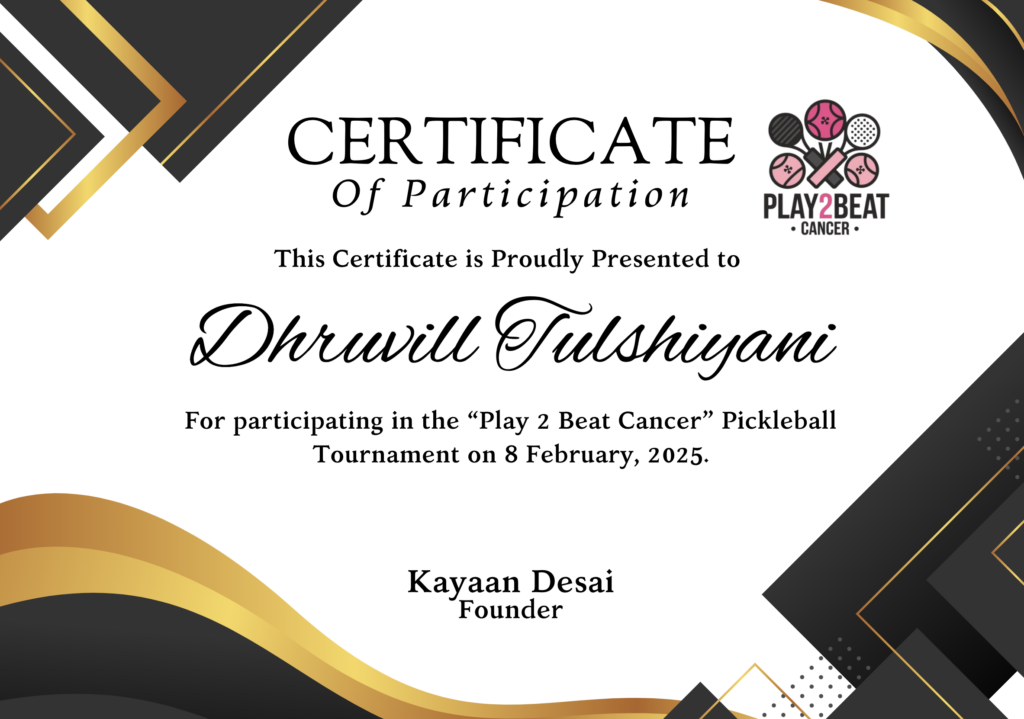
Since I was a kid, I’ve always loved sports not to be a professional, but just for the joy of playing, pushing my limits, and experiencing the thrill of competition. In 2024, I discovered pickleball and decided to try it out with my friends at different courts. To me, it felt like a mix of table tennis and lawn tennis, but I found it way more enjoyable than both. I quickly got hooked. One day, my friend Hitansh told me about a pickleball tournament organized by grade 12 students and asked me to be his doubles partner. Even though my schedule was packed, I jumped at the opportunity not just for the competition but also to complete a CAS activity.
Learning Outcome 1: Identifying Strengths and Areas for Growth
Playing in the tournament helped me recognize my strengths and areas where I could improve, both before and during the matches. Once we signed up, I knew we had to train seriously. During practice, I paid close attention to my game and realized that my agility and reaction time were my biggest strengths. I could move quickly across the court and respond to shots at just the right moment. But my serve? That needed work. So, I put in extra effort to refine it.
During the tournament, my agility and reaction time helped me score points, but I still felt I could be even faster. My serves had improved thanks to practice, but I knew they could be better. After the tournament, I reflected on my game and saw that while I had made progress, there was still room for growth. This experience showed me that no matter how good you get at something, there’s always a way to improve.
Learning Outcome 2: Taking on Challenges and Learning New Skills
I went into the tournament knowing my serves were weak and my coordination wasn’t great. Instead of avoiding these challenges, I embraced them. During practice, I focused heavily on my serves because I knew a weak serve could cost us points. Through repetition, I learned a more efficient technique and put it to use in the tournament. While my serves were much better, I still felt like there was more room to grow, which kept me motivated.
Another big challenge was staying calm under pressure. In the first round, I got frustrated when my teammate made mistakes and wasn’t playing as I expected. I lost my temper and even shouted at him during the game. We ended up losing that match, and afterward, I realized my frustration had hurt our teamwork. I knew I had to change my approach. In the next round, I focused on staying calm by controlling my breathing. This helped me keep my composure and concentrate on my own performance, which ultimately led us to victory. Learning how to manage my emotions was a valuable lesson that I’ll carry with me beyond just sports.
Learning Outcome 3: Planning and Organizing a CAS Experience
Beyond the excitement of playing, this tournament was also an opportunity to complete a CAS activity. When I first heard about it, I knew it was the perfect chance to do something I enjoyed while also fulfilling CAS requirements. Balancing the tournament with schoolwork and extracurriculars wasn’t easy, but I managed it by creating a structured training plan with my teammate.
We decided to practice on Mondays, Wednesdays, Fridays, and Saturdays to ensure we had enough training time. However, we had to adjust when unexpected plans came up, and we missed our Friday session. To make up for it, we extended our Saturday practice. Initially, I thought balancing everything would be overwhelming, but with good time management, I kept up with my studies, extracurriculars, and training without sacrificing any of them. This experience reinforced how important it is to plan ahead and stay adaptable.
Learning Outcome 4: Staying Committed and Pushing Through Challenges
Throughout the tournament and training, I had moments when I felt exhausted or unmotivated. Sometimes I wanted to postpone schoolwork or skip training sessions, but I stayed committed to my schedule.
What kept me going was thinking about the consequences: if I skipped training, I’d play poorly in the tournament; if I focused too much on the tournament, my academics would suffer; if I neglected extracurriculars, I’d miss out on other important experiences. Keeping these factors in mind helped me stay disciplined and push through, even when things got tough. This mindset will definitely help me in future challenges, whether in academics, sports, or life in general.
Learning Outcome 5: The Power of Teamwork and Communication
Teamwork played a huge role in both our training and our performance in the tournament. When we planned our training schedule, my teammate and I made sure to communicate well so we could balance practice with our other commitments. When we had to change plans, we adjusted together to make sure we got enough practice time.
During the tournament, our teamwork was tested. In the first round, I let my frustration take over and it affected our performance. After losing that match, I realized we needed to work better as a team. So in the next round, instead of criticizing my teammate, I encouraged him while focusing on my own game. He did the same for me, and that shift in mindset helped us win. This experience taught me how crucial teamwork and communication are in achieving success.
Learning Outcome 7: Understanding the Impact of Choices and Actions
The tournament showed me how much our actions and decisions influence outcomes. In the first game, I let my frustration get the best of me, which weakened our teamwork and ultimately led to our loss. After the game, I reflected on my behavior and realized I needed to change my approach. I apologized to my teammate, focused on staying calm, and encouraged him in the following matches. This small change had a huge impact—not just on our performance, but on our overall experience in the tournament.
Although we didn’t win the whole tournament and were eliminated in the third round by a narrow margin, I left the court feeling proud. I had given my best and, more importantly, learned valuable lessons about patience, self-control, and teamwork.
Conclusion
This CAS experience was incredibly rewarding. It helped me improve my weaknesses, like my serves and coordination, while also refining my strengths, such as my agility and reaction time. More than that, it taught me valuable life skills how to stay calm under pressure, manage my time effectively, stay committed, and work well with others.
Even though we didn’t win the tournament, I walked away with something even more valuable: growth. This experience made me a better pickleball player, but more importantly, it made me a more disciplined, self-aware, and collaborative individual. And that, to me, is a win in itself.