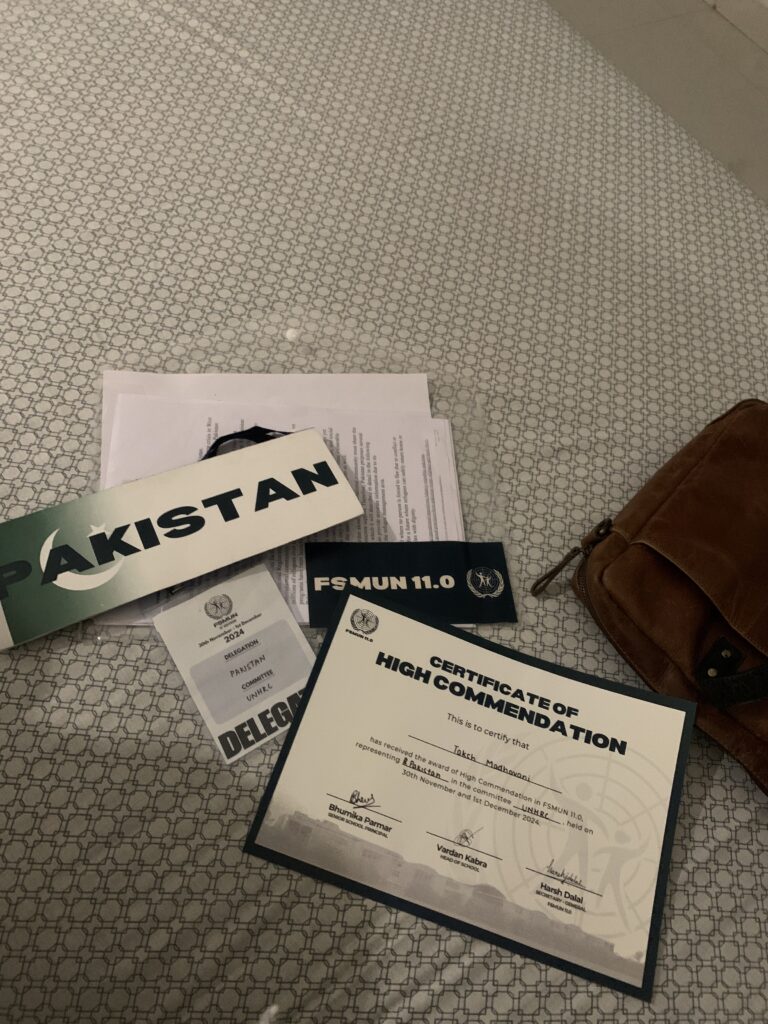
Participating in FSMUN 11.0 as the delegate of Pakistan in the UNHRC was one of the most exciting and challenging experiences I’ve ever had. It wasn’t just about committee sessions or winning awards—it was about growing, learning, and pushing myself out of my comfort zone. I ended the conference with the High Commendation award, but honestly, the journey was the real reward. Here’s what I learned during this conference :
LO 1: Identify your own strengths and develop areas for personal growth.
Before this conference, I was frightened about how I would defend Pakistan in UNHRC, but there was a lot more than that. During the committee session, I felt confident answering my fellow delegates and defending Pakistan’s stance under pressure. One thing I found difficult was my ability to manage my time, most of the time, I used to be short on time during the moderated caucus.
LO 2: Demonstrate that challenges have been undertaken, developing new skills in the process.
This conference was filled with a lot of challenges along the way, such as defending controversial policies, negotiating alliances, and navigating the fast-paced discussions. During the crisis, I improved my critical thinking skills, crafting responses that aligned with Pakistan’s position. I levelled up my collaboration skills, working with delegates from my bloc who sometimes had ideas exactly opposite to mine. These skills helped me improve not just as a delegate but as a person.
LO 3: Demonstrate how to initiate and plan a CAS experience.
MUN isn’t something you could just show up for and wing. It took me two weeks of preparation: researching Pakistan’s policies, and writing and practising speeches. I knew I had to be ready for anything.
During the conference, I took the lead in forming alliances with other delegates and drafting resolution clauses. It felt empowering to step up and take initiative, especially when I saw how my contributions helped shape the outcome.
LO 4: Show commitment to and perseverance in CAS experiences.
I won’t lie—this conference was exhausting. Between long committee sessions, intense debates, and the constant pressure to defend my country, there were moments when I felt drained. But giving up was never an option. I stayed up late refining my speeches and working on resolutions, determined to do my best because I knew that walking away with just a certificate of participation was the last thing I wanted to do. Perseverance paid off in the end, and I walked away proud of what I had achieved.
LO 5: Demonstrate the skills and recognize the benefits of working collaboratively.
Collaboration was one of the most important (and sometimes challenging) parts of this MUN. Working on resolutions meant finding common ground with delegates who had very different priorities. I learned how to listen to others, respect their perspectives, and find creative solutions that worked for everyone. One of my favourite moments was leading a bloc to draft a resolution that brought together a wide range of ideas while staying true to Pakistan’s stance. It was a real reminder that teamwork can achieve so much more than going it alone.
LO 6: Demonstrate engagement with issues of global significance.
The agenda of the UNHRC focused on human rights issues such as the refugee crisis in West Asia. Representing Pakistan meant diving deep into these topics and understanding the complexities behind them. Debating these issues made me realise how interconnected the world is and how every country brings a unique perspective to the table. It also helped me appreciate the role of diplomacy in addressing the current refugee crisis across the globe. This experience inspired me to stay engaged with international issues and continue learning about how we can make a difference.
LO 7: Recognize and consider the ethics of choices and actions.
One of the hardest parts of this MUN was sticking to Pakistan’s official stance, even when I personally disagreed with certain policies. But that was part of the challenge—learning to separate my personal beliefs from my role as a diplomat. I made sure to represent Pakistan honestly and ethically, while also respecting other delegates’ viewpoints during debates. This taught me the importance of staying true to your role while maintaining respect and integrity, even in tough situations.
To conclude, FSMUN 11.0 was so much more than a conference for me. It was a chance to grow as a communicator, a collaborator, and a global thinker. It taught me how to stay resilient under pressure, embrace challenges, and engage with issues that really matter. I’ll carry the lessons I learned here with me for the rest of my life. FSMUN wasn’t just about debating policies—it was about becoming a more informed, empathetic, and capable person.