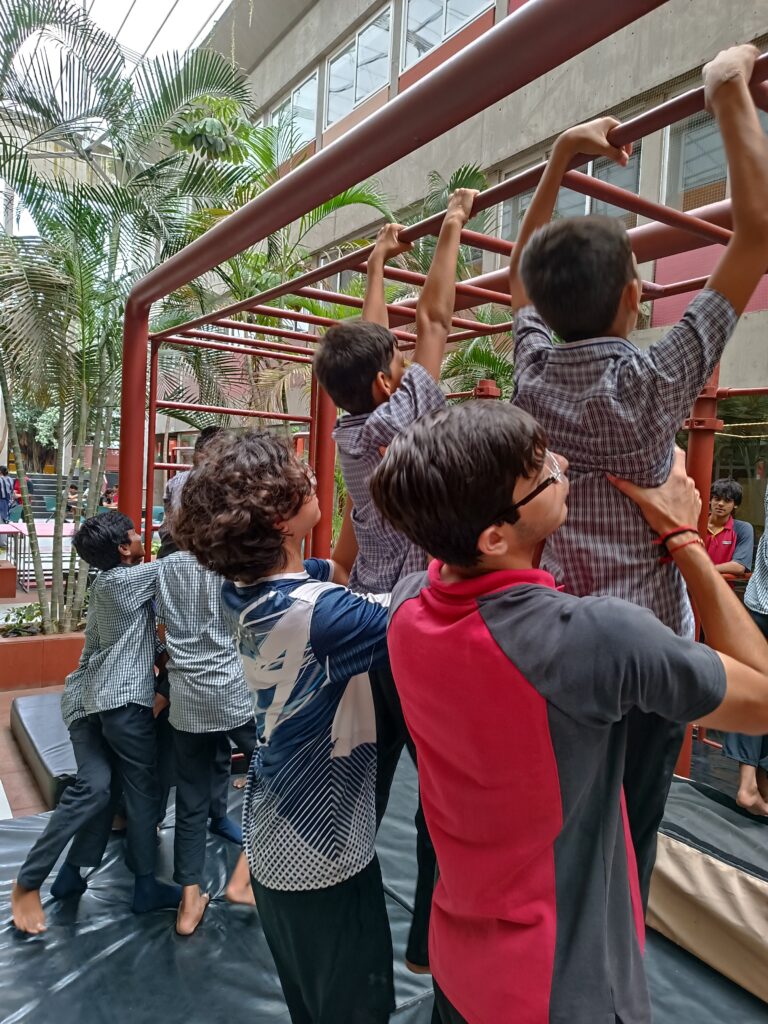
| I spent around 2 hours each day for 3 weekends to teach a group of children from different school calisthenics skills. I, along with my group, taught the children stretches, exercises, and proper technique to increase muscle mass and strength while doing bodyweight workouts. This includes pullups, planks, pushups, squats, dips, crunches and more. As a group, we pushed the children past their comfort zone and into difficult situations in which they learned resilience in the face of challenges, which is exactly what is required to improve in calisthenics. |
LO2: Demonstrate that challenges have been undertaken, developing new skills
To begin with, there were multiple challenges that I faced during the community service along with my group. One such problem was communication, as some of us were not fluent in Hindi or Gujarati, leading to some breaks in understanding. To solve this, we made critical use of what knowledge we did have as well as body gestures to send across the same messages. Another challenge was present in keeping the children safe. We had to have constant surveillance over each child and make sure that they were using the equipment properly and were in no danger. Through this, we developed the skills of organization and critical thinking to divide the children into groups and place precautionary cushions in the event of a fall.
LO3: Initiate and plan a CAS experience
I was highly involved in the initiation and planning of this CAS experience. My team and I conducted multiple meetings which involved planning of the types of exercises we would teach the children, how we would split them up, and dividing roles between us. As a group, we had to contribute in the initiation of this experience by creating the whole thing from start to finish without any outside help.
LO4: Show perseverance and commitment in CAS experience
Perseverance and commitment were huge parts of the CAS experience. This community service spanned 3 weeks, with all volunteers having to wake up at early hours and head to school on their weekends. It took a high amount of commitment to teach the children at such early hours for such an extensive period of time and was a true testament to our willingness to help the community. We also had to spend extensive time planning out the experience for maximum enjoyment of the children, which took up large sections of our free time. Through our experiences in the first couple days, we reflected on what went well and what could have been improved and worked upon the same in the next sessions, showcasing a truly strong commitment to making the service the best it could be, persevering through challenges.
LO5: Demonstrate skills and benefits of working collaboratively
We had to work together as a team to teach the children, allowing us to clearly demonstrate skills of working collaboratively. There was extensive communication between all of us, showcasing strong social skills. We each had to divide up roles and trust each other to fulfill said roles with excellence, so a faith in my teammates was required. There were many benefits of working collaboratively, as it gave each of us a much smaller and more focused load of work, allowing us to increase the quality of feedback and attention we could give to each child.
LO6: Engagement with issues of global significance
The lack of health in children has been rising in recent years globally. Over time, children have stopped exercising and prefer to stay inside or use technology. However, this has led to a global health crisis, with a huge percentage of people facing either malnutrition or obesity. Scientifically speaking, a healthy body is one that avoids health risks, and the best way to make a stronger body is to use it. If people are not using a certain part of their body, it is liable to become a weak part that may be more susceptible to disease. Similarly, those who do not exercise in any shape or form have no way to build muscle, which sometimes leads to extreme measures of either a full lack of muscle or an excess of fat, as that is the building material for muscle. By teaching the students how to exercise and gain muscle through calisthenics, they are much more informed about what to do to stay healthy. This engages the issue of global significance by addressing the huge problem of unhealthy wellbeing that most people suffer from.