On the 30th November and 1st December, I participated in the FSMUN, 11th edition, as part of the International Press (IP) committee as a reporter. Each day lasted over 12 hours, from 7:30 am to 7:45 pm and though it was long, I enjoyed and welcomed the new experience. Previously I had done 2 MUNs but I’d always wanted to be selected for IP since it would be a new experience where I could experience being a journalist and getting to visit various committees and see how they work.
As a reporter in IP, my main role was to stay in UNHRC (United Nations Human Rights Council) as I volunteered for that committee, almost the entire day and note down any important things that happened; any controversial thing a delegate of a country said, important actions taken, responses to certain questions, and many more. Furthermore, I had also used this information as well as voice recordings during open floors and other heated debates, to create a daily report both summarising the events of the day and discussing the impacts of what certian delegates may have said or done. Lastly, I also had to conduct an interview for which I chose to interview the delgate of the UK, who was usually at the center of debates, especially after the crisis.

LO1 Identify your own strengths and develop areas for personal growth
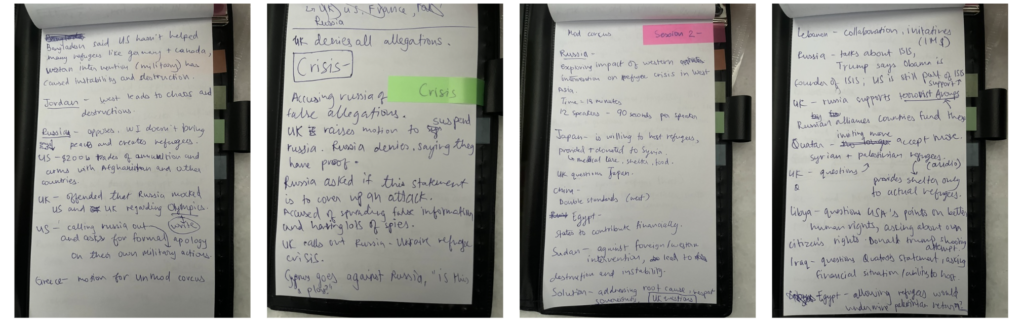
My strengths were being able to take quick notes of everything that was going on… and in 6 sessions that were approximately 2.5 to 3 hours each, there was a lot constantly happening that I had to keep track of. In these two days I had filled more than half of my notepad with notes of the sessions along with lengthy voice recordings in order to keep track of all the events and have enough information to write the report. Furthermore, I developed and learnt skills important for journalism such as conducting interviews, formulating questions for the same and writing a report as a summary of the events of the day.
LO2 Demonstrate that challenges have been undertaken, developing new skills in the process
Personally, as mentioned earlier, one of the main challenges was learning to formulate questions for the interview. The reason it was so challenging was because it was unlike anything I’ve ever done since I am so new to journalism, I’ve also never seen an interview or press conference in MUNs so I was unclear as to how the questions should be framed. My vice chair guided me by suggesting what I could ask and potential follow-up questions. While she helped me develop most of the questions (which I then framed), I aim to take on this task independently next year, applying what I have learned to fully develop these skills.
LO4 Show commitment to and perseverance in CAS experiences
MUNs are an exhausting endeavour, 2 full 12 and a half hour days with hours long committee sessions. Fortunately I wasn’t directly a part of the debate, but I constantly had to keep on my toes and make sure to quickly note down every important thing countries were saying… which filled up 70% of my notepad by the end of the two days. Despite the exhaustion and sleep deprivation, I still persevered and continued to do the required work in order to develop the skills of a journalist and win an award or special mention (though I later found out they didn’t have one for IP).
LO6 Demonstrate engagement with issues of global significance
At UNHRC, the subject was “Addressing the refugee crisis in West Asia”, which primarily included the refugee crisis in countries like Syria, Afghanistan, Lebanon, Libya, Yemen and more. Although I wasn’t a part of the committee, I did write about it and observed most of the discussions that were happening between the delegates, where I gained a lot more knowledge about the refugee crisis in West Asia; what were the primary causes of the conflicts and therefore reason to move, which countries were the hosts and from where most of the refugees came from, what each country was doing to help the refugees and host countries and more importantly the actions taken and future solutions each country will provide for the same.
The refugee crisis is globally significant as it impacts the socio-economic of millions of individuals, talks about humanitarian efforts and international security. The refugees strain resources in host countries as well as create complications and ethical dilemmas between choosing what’s best for the refugees and prioritising their own citizens. Furthermore, the refugee crisis that’s caused by large scale conflict, persecution and instability, causes millions to flee their homes and face countless challenges. These include loss of livelihoods, limited access to basic services like education and healthcare, and the trauma of displacement. These people often struggle to rebuild their lives and find stability even in their new homes.

Additionally, I had been present in a few press conferences of various other committees like Lok Sabha and WTO (World Trade Organisation) where I learnt a lot about the kinds of questions asked by the press to delegates of countries and memebers of Lok Sabha, which to me was quite interesting. I learnt what kinds of responses they might give to the press, and a glimpse of the agendas and events occuring in these committees, since I had only been assigned to UNHRC.
LO7 Recognize and consider the ethics of choices and actions
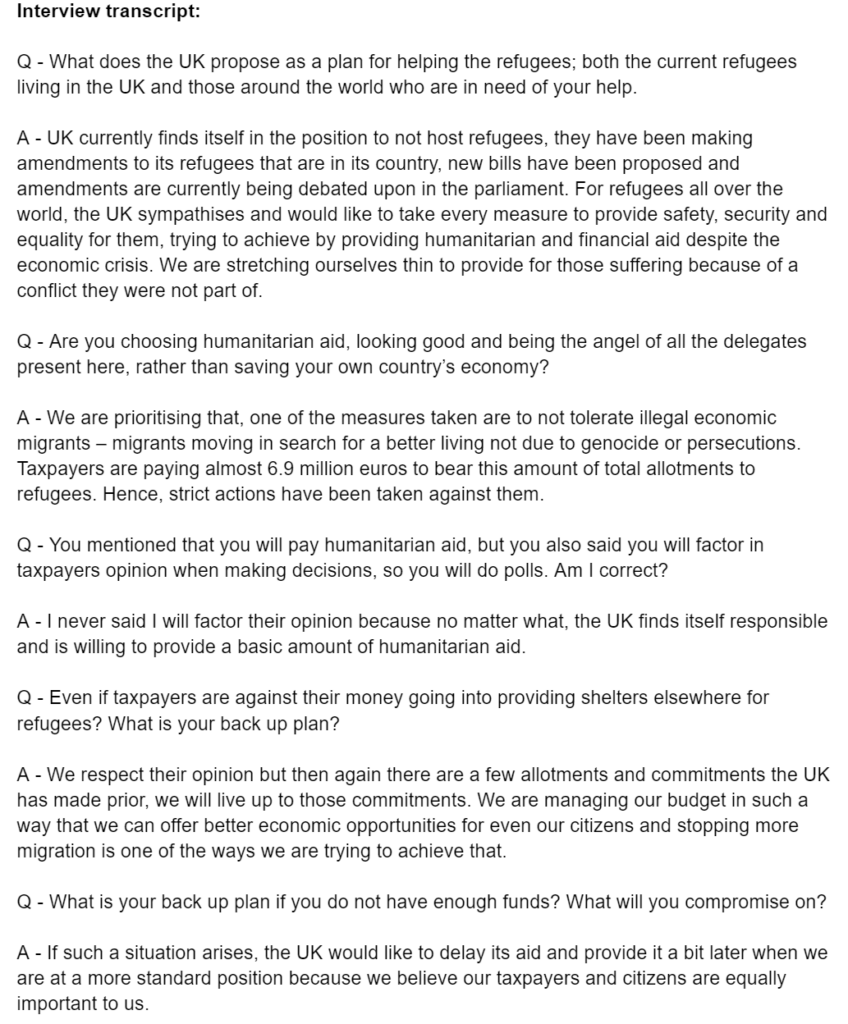
Though I wasn’t a direct part of the committee, I had observed very closely and ensured I understood each part of the discussion. One particular topic that was important was the UK’s policies about refugees and what actions they would take regarding refugees who illegally or legally entered the UK. My interview with the delegate of the UK highlighted their laws regarding refugees who sought out aid for the UK, and their plans for them, while still mainting that the UK should make choices based on the taxpayer’s opinion and to support their own crashing economy. Here, the ethics were key since no matter what the UK did, there would be ethical complications. Hence, the delegate acknowledged the difficulty in making ethical decisions under such constraints, revealing how the UK navigates its responsibilities toward global refugees and its citizens. She stated that “UK currently finds itself in the position to not host refugees, they have been making amendments to its refugees that are in its country, the UK sympathises and would like to take every measure to provide safety, security and equality for them, trying to achieve by providing humanitarian and financial aid despite the economic crisis”. While also adding that “We respect their *taxpayer’s) opinion but then again there are a few allotments and commitments the UK has made prior, we will live up to those commitments”.
By prioritizing humanitarian aid despite the economic strain, yet also taking necessary measures to safeguard its economy, the UK is illustrating a complex ethical dilemma where every decision has consequences, both globally and domestically.
Overall, I thoroughly enjoyed the experience and learnt a lot by observing committees and press conferences (which was a first for me). I learnt how to formulate questions, which I did for the interview with the help of my Vice Chair — how to make these questions effective in obtaining useful information, precise and impactful. I also gained knowledge regarding how to write a report as a journalist and about how press conferences work within different committees like the WTO (World Trade Organisation), Lok Sabha, UNSC (United Nations Security Council) and more.
I am also looking forward to taking a part of IP again so I could get even better at formulating questions and hopefully being a part of a press conference and asking questions.
